Director of Education Policy Avrum Tomer published an in-depth essay in HaShiloach quarterly journal on Michael Walz‘s moral framework of just wars, upon which the IDF ethics code is based, pointing out its actual inherent immorality and its contribution to the October 7 failures, and proposing a new moral framework better suited to the realities in Israel.
Summary:
The IDF’s “moral bible”, the book that shapes its military ethics as it does that of other militaries across the West, as well as forming the basis for modern laws of war, is Michael Walzer’s Just and Unjust Wars(1977). Among the many aspects of the October 7 failures, we must also examine whether and how the IDF’s military ethics played into the hands of our enemies. Beyond a discussion of the IDF’s Spirit of the IDF code itself, this is a direct critique of the Walzer-influenced military ethics that underlie it, concluding by a proposal for new foundational principles that rethink what a just war means. To that end, two complementary arguments are set forth:
- On the level of fundamental ethics – Walzer’s and his followers’ conception of war is unjust, because it prevents ‘victory’ in the conventional sense of the word, and incentivizes unethical belligerents to embed themselves within the civilian population, thereby causing far greater harm to that very population and prolonging wars, sometimes indefinitely.
- On the concrete level of Walzer’s philosophical development, the real challenges facing the State of Israel, and Walzer’s attitude toward them – it is clear that Walzer’s conception of just war has changed over the years, and despite the understanding in his early work of exceptional circumstances for wars of survival, and a new understanding of the way ethical military restrictions are abused by unethical belligerents, he imposes on the IDF stricter rules than those he himself formulated in his foundational book, and in effect, condemns Israel to either annihilation or repeated battles at high cost.
Walzer’s Ethics
Walzer posits two facets to morally analyzing a war: (i) the justification for its initiation, and (ii) its conduct. On the first, his contention is that the only justification for war is self-defense. Preemptive strikes against an enemy wishing one harm may be justified, but he sets the bar high in proving that harm is indeed imminent. Declarations of intent to do harm, for example, are insufficient without concrete actions or military preparations. Walzer dedicates far more time to the second aspect, with a major premise being that which side had just cause to fight is irrelevant to the question of just conduct once hostilities have begun. The right and wrong of fighting is judged behind a veil of ignorance, irrespective of a belligerent’s war objectives or guiding norms.
The context in which this theoretical blind and artificial separation between the two questions must be understood is the conception of ‘moral universalism’, which seeks to avoid the question of which side is the aggressor and which the defender. The moral atmosphere in academia at the time Walzer’s book was published was shaped by the Cold War, when many American intellectuals identified more with the Soviet side. They similarly viewed the Vietnam war as unjust. Therefore, they sought to set aside who was right and focus on how to conduct wars, thus circumscribing American and Western action.
This framework is also applied to Israel, which despite being under constant threat from its neighbors, and continually defending itself against violent terrorism, attacks on its civilian home-front, and existential threats, is perceived by Israeli academics, particularly those engaged in military ethics, as the stronger party, and the one principally culpable for the Israeli-Palestinian conflict – within which Hamas carried out its horrific acts on October 7.
In general, the natural division between a good side and a bad side has been subjected to fierce philosophical academic assault since the 1960s, as part of an entire ethos that Western society has been instilling in its young people in recent decades, according to which there are no good or bad cultures, no enlightened or benighted regimes, only social situations that can turn any individual into a sadist or a Nazi. This is why the principal message taught in the education system ahead of Holocaust Remembrance Day is no longer ‘Never Again’, which sanctifies Jewish sovereignty and emphasizes the vital importance of Jewish power, but rather how we can prevent ourselves from becoming Nazis, since the dormant potential resides within us all.
Walzer also argued that limited war would more easily pave the way to peace, as though it is a given that limiting force and extending a hand are what bring peace closer, not, equally possibly at the very least, breaking an enemy’s power and causing them to despair of achieving their goals through force. It is safe to assume that to the contrary, the more enemies are driven by extreme and deeply rooted ideologies, the smaller the chances of dissuading them from war by appealing to their reason and finding middle ground. But when the prevailing worldview is that evil stems from problematic conditions rather than toxic ideologies, we are permitted only to aspire to change those conditions, not to destroy evil enemies or subject them to extensive cultural transformation.
Victory in Walzer Ethics
In his book, Walzer posits: “Belligerent armies are entitled to try to win their wars, but they are not entitled to do anything that is or seems to them necessary to win”.
During the current war, Prof. Avi Sagi – one of the authors of the IDF’s ethical code – echoed both sentiments:
‘This point of striving for victory, and viewing the war in such a way that there is one party – the State of Israel – that strives for victory, and on the other side there is whoever needs to be defeated – produces blindness, moral blindness… The State of Israel has attached to itself a principle … that Israel is the good side, and on the other side there are the evil ones, and this is a metaphysical war between good and evil.’
The possibility that victory itself is a moral obligation, that it can contribute to the advancement of world peace, and that the failure to defeat a particular enemy is in itself a moral failing, since that enemy will continue to commit crimes and cause deaths, was not considered.
Indeed, Walzer’s students, who drafted the IDF’s ethical code, knew clearly that they were preventing the IDF from winning. This was a goal that was placed openly on the table, as Professor Asa Kasher said: “‘Victory’ may be effective on the emotional level, but it is problematic from a professional standpoint… It is better to replace the elusive term ‘victory’ with the expression ‘achieving objectives through the execution of missions.'”
The motivation behind this conception is explicitly rooted in the internalization of the Walzer’s ideas. Our power supposedly obligates us not to win our war against terror, but to sacrifice ourselves for the sake of our morality.
This conception is as mistaken as it is widespread, and it is time to uproot it.
The Rule of Distinction
The most important set of rules that Walzer defined, which in recent decades has influenced the manner in which the IDF contends with our enemies, are those dealing with the principle of distinction – separating between combatants and non-combatants. There is universal agreement that it is permissible to strike the enemy’s military forces and all those who directly assist them, and likewise that deliberate harm to those who are not involved is unjustified. However, more complex situations raise issues – What degree of civilian involvement in enemy action justifies striking them? What is permitted when the enemy’s forces are intermingled with their own civilian population?
According to Walzer, a main tenet of the distinction principle is that enemy civilians are to be preferred over one side’s own soldiers. This was endorsed by many Israelis, including some of the authors of the IDF’s 2000 moral code, such as Prof. Moshe Halbertal. The underlying assumption is that soldiers are not emissaries of a specific society, nor the defenders of a specific nation with which they identify and are identified. Soldiers are instead conceived of as a kind of policing organization whose purpose is to protect non-combatants from harm, wherever they may be. In the name of this mission they are expected to be drafted, leave their families, risk their lives and even to lay them down if necessary, “without any regard for their feelings toward the various groups of civilians” (as Michael Walzer and Avishai Margalit put it in Haaretz).
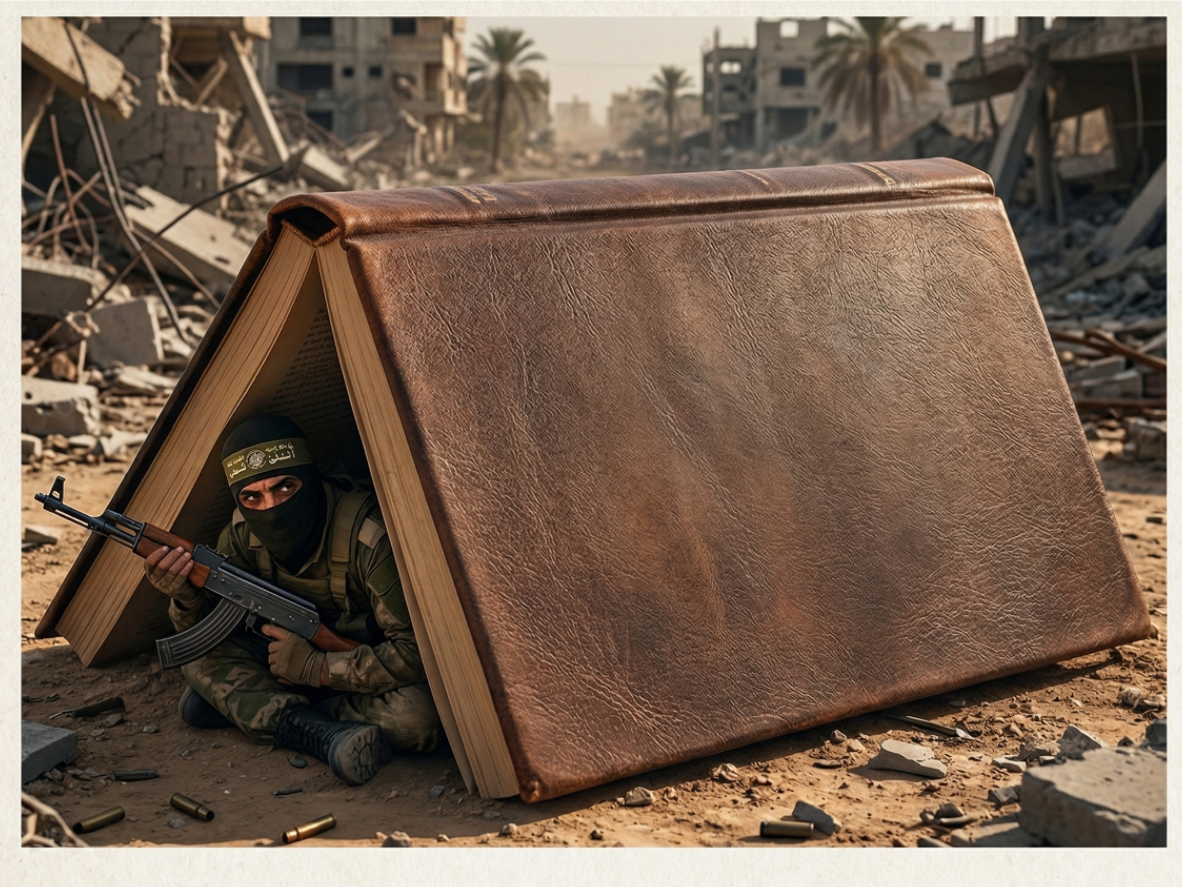
However, despite Walzer’s presumably good intentions in his ideas of just warfare, his moral distinctions served the jihad in its war against Israel extremely well. Terrorist organizations internalized the moral code he formulated and exploited its effects to the fullest. His distinctions between legitimate and illegitimate targets, and the proportionality rule by which the importance of the objective must outweigh the scope of collateral damage, determined the manner in which the Palestinians prepared for war. They broke every record of cynicism and built their strategy so that the IDF would be forced to endanger their soldiers, kill non-combatants, strike sensitive civilian infrastructure, and thus cause enormous collateral damage, bringing harsh internal and international criticism that would compel it to stop short of achieving victory.
Wars of “Supreme Emergency”
Walzer made exceptions for wars of emergency, such as the war with the Nazis. He understood that when it comes to survival, a nation is justified in using all means necessary to prevent the enemy from winning, because defeat in such a war would not lead to some minor loss such as a border adjustment or loss of prestige as in most conventional wars, but to “the sacrifice of national independence or perhaps the expulsion and murder of millions of people.”
Yet this exception inadvertently deviates from his foundational assertion that the question of a war’s inherent justness can be separated from the question of just conduct in war, since Walzer is willing to accept an expansion of the range of permissible means to achieve victory in a war of survival. This means that the question of the justness of the war does bear upon the just conduct within it, and the sharp separation Walzer himself established becomes blurred.
Given the exception, the war forced upon us on October 7 seems one of those ‘supreme emergencies’, similar to that of Britain in World War II. Does Walzer then justify a more permissive policy of conduct? Is the radical Islam we face equal to Nazism?
The answer lies in the question of what Walzer thinks distinguishes World War II: the magnitude of the military threat, or the intensity of the enemy’s evil and cruelty?
It would appear to be some combination of both elements, yet it seems evident that it was the pure, clear, undeniable and unobscured evil that led Walzer to concede that there are cases in which it is right to strive for total victory, the unconditional surrender of the enemy and their cultural rehabilitation. This can clearly be applied to the radical Islam that surrounds us, embodying a distilled, bloodthirsty and uninhibited evil, brought clearly to light on October 7.
And indeed, at the outset of the war Walzer published an article supporting Israel, and agreeing that the defeat of Hamas was a moral necessity, “demand[ing] a moral toughness that is not always admirable”. He said Hamas had made it impossible to avoid civilian casualties, and Israel must not be made to adhere to standards so high that everything it did would be unlawful and unjust.
However, he qualified this assessment, stressing that Israel still must meet moral requirements regarding targeting precision, intelligence gathering, and humanitarian supply, and that Israeli commitment to continuing the war until its objectives were achieved did not preclude criticism of the manner in which it responded to the “asymmetry trap- whatever military gain it achieves from striking targets embedded in the civilian population, it loses politically from the civilian deaths it causes. Hence great caution is required”.
Thus is Walzer’s weakness exposed. He accuses Hamas of exploiting the rules of just war which he himself decisively influenced, as he looks upon his own intellectual creation drowning in a sea of cynicism – and is powerless. His advice to Israel not to fall into the political trap positions him as a kind of neutral observer, despite being, in fact, a central and highly influential player – even the oracle of permissible conduct. Had he argued publicly that the rules he crafted were not relevant to cases of cynical and cruel enemies that exploit them; that an army need not care for an enemy’s civilians more than their own government does; that whoever declares that they ‘love death as our enemies love life’ cannot enjoy the protections afforded to those who respect life, he could have helped Israel, by virtue of his standing, to avoid that same trap by losing less politically and receiving more international backing, paving the way to victory.
Walzer’s initial statement that we must win is meaningless when he does not permit us to employ the necessary means to do so. No state has ever been required to avoid all collateral killing of civilians. He does, admittedly, ‘permit’ the IDF to strive for victory, but it appears that even he knows that under the rules he himself defined, the wars forced upon Israel on its various fronts will be extremely lengthy and unbearably costly. It is hard, then, to escape the conclusion that Walzer does not truly care whether Israel ‘wins,’ in the old and classical sense of the word. And indeed, in an interview marking one hundred days since the war began, he stated that ‘victory must be redefined. It cannot mean the complete destruction of Hamas, but rather preventing Hamas from governing Gaza.’
The only explanation for Walzer’s shift is that like many others in the world, he saw Israel as a victim in the immediate aftermath of October 7, when he published his article. He therefore allowed himself to support Israel’s objective of victory – even though the war ethics he formulated do not allow for the achievement of that objective. As the war progressed, however, his support became increasingly qualified, and he changed the concept of victory to reaching a deal that would end the war with an Israeli claim to victory, just as in the previous rounds of fighting.
Walzer retreated from his support to such an extent that following the brilliant pager operation against Hezbollah commanders, which was an unprecedented surgical operation, he published a sharp critical article against striking those commanders when they were not engaged in military activity but residing in civilian areas. He also criticized the IDF’s decision to kill Hamas leader Ismail Haniyeh in Tehran while negotiations with Hamas over the release of the hostages were underway.
The conclusion for Israelis from his later stance is clear: if the high priest of military ethics opposes even an operation such as the pager operation, his doctrine – on which every IDF officer of the last generation has been educated – must be replaced as soon as possible with a better one.
Our “Morality” is what Sustains Hamas
Military strategists are required to analyze what constitutes their enemy’s center of gravity, the destruction of which may bring about its defeat. Hamas’s advantage is that it has no concrete center of gravity. It is willing to live under the harshest conditions, such that no Western society would be capable of enduring over time. For the terror organization, mere survival is victory.
In point of fact, Hamas’s center of gravity is our own hesitancy and moral self-doubt. The fetters shackling us are placed there by our own hands. Hamas knows full well that the war ethics we have adopted lead almost by definition to its survival, and is willing to absorb heavy damage in order to raise the moral cost of our war; thus causing us to lose international and domestic legitimacy to continue, and forcing us to end the fighting without decisive victory. Hamas’s logic is the inverse of ordinary military logic: the more non-combatants on its own side it causes to be killed, the smaller the chances of harm to its own soldiers and commanders – because the war will end sooner. Though perhaps counter intuitive, this is the truth: Hamas’s center of gravity is not located in its territory but in our minds.
In order to defeat the Gazans in battle, it would have been sufficient to employ resolute and ruthless conventional force, impose a siege for a limited period of time, and conduct a far more massive and less surgical campaign to crush the terrorist organizations, at minimum cost in the lives of IDF forces.
Note that the IDF took control of the Philadelphi Corridor only after considerable delay, and only then was control over supply routes achieved. Had Israel prevented all humanitarian supply, including water, Hamas fighters would have been unable to continue fighting within a matter of weeks, below ground or above. It is reasonable to assume that such a course of action would also have endangered non-combatants (at least those who would have refused to evacuate to external humanitarian zones), which is why we were not ‘permitted’ to adopt this strategy. (Walzer has actually shifted his position since the 1970s: in his book, siege was deemed a legitimate instrument of war as long as there existed a controlled outlet allowing non-combatants to exit its boundaries).
Throughout the months of fighting, Israel did not receive international legitimacy to act in this manner, including from Walzer himself, and the legal authorities in Israel adopted the stricter rules and compelled the political echelon and the IDF to permit the entry of humanitarian supplies into Hamas’s hands without any binding reciprocal commitment – at the expense of our soldiers’ security.
Killing the Radical Islamic Idea
Radical Islam despises the West and regards death for God as a supreme value. It has no need for military superiority, for it assumes that its willingness to fight to the death will exhaust weary Western armies, and that in the absence of a center of gravity that would lead to victory by its destruction, such armies will prefer to reach a settlement rather than be drawn into a grinding war of annihilation.
But one can, in fact, kill an idea, and the way to do so is by delivering a blow powerful enough to bring the society and its leaders to despair of the path they have taken. Just as victory over the Japanese required extreme and stunning action, so too we must seek and find what can produce a similar outcome among the Gazan population, and pursue it fearlessly, secure in the moral righteousness of this goal. Only thus can we be certain that the jihadist idea will be crushed, and a different, peace-seeking path made possible. The precondition for achieving such victory is defining victory as the unconditional surrender of the enemy; otherwise no decisive motivational transformation will occur. There is no more moral goal than this, and any means that brings it about will also save much bloodshed, in our generation and in generations to come. To this end, the foundational principles of a new war ethics must be laid.
A New Theory of Ethics
- The justness of the war. In many cases, and not only in the war against the Nazis, it is impossible to separate the justness of going to war from justice in the conduct of war. The justness of the war also bears upon the importance of winning it. This is not a war between ‘two sides who each believe their war is just,’ and which is right cannot be determined. Total victory over radical Islam is the victory of good over evil, and it carries supreme moral and historical importance. This intuitive conception – pompously regarded as childish by certain intellectual circles – is the vital foundation that enables a people to exist, and to mobilize in times of distress. Without it there is no sense of ‘us,’ no sense of mission and belonging, and no reason to fight and certainly not to risk one’s life and make sacrifices.
- War against a people. We are not fighting an army or a terrorist organization but a people and a state. This is a collective whose terrorist regime represents it, even without holding democratic elections. This is a people that educates its children toward terrorism and hatred, and is willing to sacrifice all its civilian infrastructure, all its institutions, and above all its children, in order to enable maximum harm to Israel. Palestinian society operates as a machine whose purpose is the cultivation of enmity toward the State of Israel. Those who claim that the children of Gaza are pure and innocent like our own children are ignoring the fact that as long as accelerated de-radicalization processes do not take place, they will with high probability grow up to be bloodthirsty and cruel terrorists.
- The responsibility of governments for their policies. The government in Gaza bears responsibility for its civilians, and it is not our responsibility to protect their children, women, and elderly. The principle of distinction remains intact – but the culpability for collateral damage caused by the failure to separate the fighting force from the rest of the population rests entirely on the shoulders of the Gazan government. Every morally minded person who feels pain at the unnecessary loss of human life must understand that the current rules of ethics incentivize terrorist and guerrilla armies to embed themselves within the civilian population, meaning that these rules only prolong wars and raise the level of death long term.
- The morality of going to war (jus ad bellum). The grounds of self-defense that justify going to war must be interpreted more broadly, so that one side is not compelled to absorb an attack on its territory before it may act militarily against an enemy. An enemy clearly declaring itself in favor of your annihilation is sufficient grounds to strike, subjugate, an occupy its territory temporarily or permanently, and demand a thorough transformation of consciousness, culture, and education. Moreover, it is preferable to surprise and strike when the enemy is unprepared, or before it has accumulated strength.
- Justice in war (jus in bello). It is obligatory to do the minimum necessary that may bring about the enemy’s surrender as quickly as possible. The need for victory is not affected in the slightest by the magnitude of the threat the enemy poses at any given moment; that is a temporary state that can change, and any pursuit of proportionality and reciprocity stems from moral vertigo and a loss of a moral compass. Subjugating the enemy is justified the moment it is clear beyond any doubt that it wishes to harm us and desires our destruction. Only after an enemy surrenders can one extend a hand toward the rehabilitation of relations and building a better future for both sides. The enemy can surrender unconditionally at any moment, and in doing so end the cycle of bloodshed and turn toward the path of peace. Since the only two considerations are the speed of surrender and the minimization of harm to our forces, the actual collateral damage may be more extensive than what has been customary in the current rounds of fighting. At the same time, it is important to emphasize that any violent action that does not serve this goal, but is instead motivated by a desire for revenge, a passion for destruction, or sadism, is a crime that we are obligated to eradicate root and branch.
- Asymmetry in morality and resilience. One of the lessons of the war must be that what we perceive as an unbearable reality is not necessarily what Hamas perceives it to be. Just as the rules of war are not the same on both sides, so is the breaking point of each unidentical. Muslim fundamentalism is characterized by a willingness to absorb heavy casualties and widespread destruction on a scale far greater than a Western society that cherishes life and prosperity is capable of. A society that glorifies sacrifice and extols death for God has a high breaking point, but it does exist, as we saw with the Japanese nation in World War II, and it is important to reach it, precisely because of the strong religious roots that anchor it. If we aspire to encourage the moderate religious currents that exist in other Muslim societies, we must bring our enemies to despair of their extreme fundamentalism.
The best way to prevent blood-soaked wars is to maintain effective deterrence through the credible threat of overwhelming force. Israel’s current hesitant, cautious approach paradoxically prolongs the conflict and causes more cumulative death and destruction than a single resolute decisive blow would. By sustaining the enemy just enough to keep fighting, we feed their hope of survival and drag out a war that the balance of forces would otherwise quickly resolve. A war ethic that sanctifies swift, decisive victory will cause terrible damage in the short term, but will ultimately result in far fewer casualties, produce lasting deterrence, and may even bring about the cultural transformation that follows unconditional surrender, preventing future wars and all the suffering they entail.
(See the full essay in Hebrew, published in HaShiloach quarterly)