
I’ll start with a confession: When my candidacy as a member for the Council of the Second Television and Radio Authority was put forward, I decided not to waste time preparing for the job. Why? Because I had the funny feeling my candidacy would be rejected due to my being part of the Kohelet Policy Forum. In short order, it became clear that my concern was greatly underrated. Immediately following the government ratification of my appointment alongside fourteen other members, five different petitions were filed against the new Council as well as against the appointing Minister, Minister of Communications Shlomo Karhi. A mere two sessions of the Council were sufficient for Bagatz (The Israel Supreme Court) to dismiss not only me but the entire Council, and further set a legal (and perhaps international) precedent in resurrecting the previous, dissolved council after it had completed its term.
What made Bagatz take such an extreme step? Good question. I searched through the Court’s decisions and reasoning and found that silence is golden. To paraphrase Rabbi Kook, I decided to speak out not because I have it in me to speak, but because I don’t have it in me to remain silent. The painful truth is that the Israel Supreme Court chooses to act, to all intents and purposes, as a political entity. We are in the midst of a political power struggle between the elected officials who appointed the new Council and certain media bodies. The Court, meant to act as an arbitrator, chooses over and over again to protect the media clique, because it, in turn, protects the Court. “You scratch my back and I’ll scratch yours”. In the world of foreign affairs this is called a defensive alliance.
And as though it weren’t enough that the Justices preemptively choose a side, the government faced another hurdle, which isn’t new either: The AG’s office refused to defend the new Council’s appointment. We too, as Council members, discovered that the Authority’s legal counsel was not a help but a hindrance, when he refused to represent our position before the Court – neither to defend the appointment nor any issue we had had the time to discuss. That same advisor went on to add insult to injury and block us from obtaining alternative legal representation. Moreover, at the first session as Council in its new composition, we decided to ratify a decision made by the previous council. And as if it weren’t enough that our legal advisor objected to our decision and also prevented us from having any independent representation, he falsely described how our decision was reached in a letter he sent.
The incident I just described is only one in a series of events in which the Authority’s legal advisor acted unfairly towards Council members. To illustrate, I can say that to the best of my knowledge that same legal advisor did not bother to respond to a single email from a Council member from the commencement of the new Council’s term until its suspension by Bagatz. In fact, the Authority’s legal advisor did not serve as an advisor to either Council members or Chairwoman of the Council for a single moment.
The name of the legal advisor for the Second Authority is Ofir Bitan. Bitan is a Mizrahi Jew who wears a national-religious kippah, and likely votes for a right-wing party. I tried to understand what made him so set against us from the very start. But this is not a personal story about one or another legal advisor. In my experience, such cases abound. For the sake of brevity, I’ll settle for one piquant example.
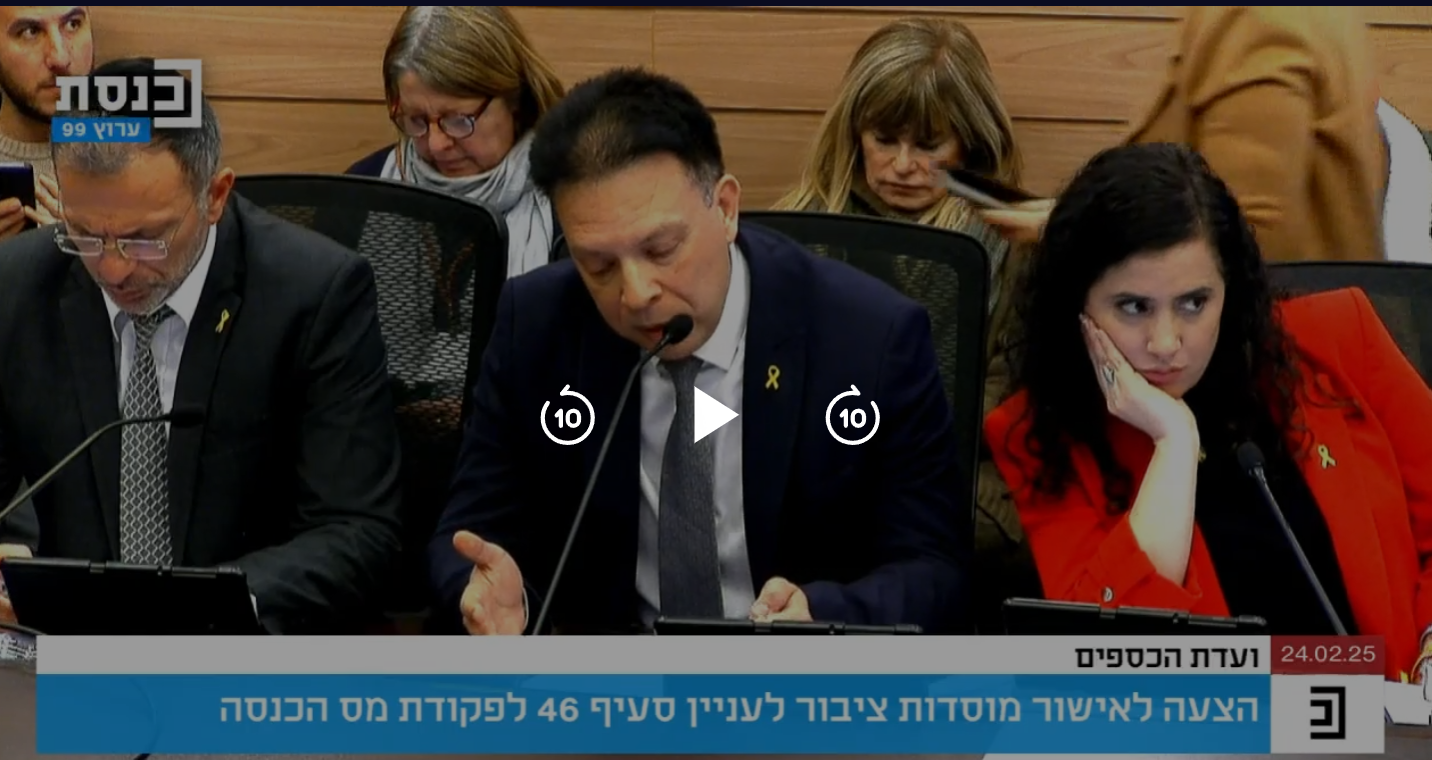
It was my privilege to represent the Forum before the Knesset’s Finance Committee when it convened to ratify the section 46 tax exemption status to a group of civil society organizations of which Kohelet was one. When an anonymous MK invoked the baseless argument that Kohelet was party-affiliated, the Tax Authority’s legal counsel jumped in immediately to announce that such an accusation would be thoroughly investigated, and only after four more meetings and countless reviews did Kohelet donors receive the tax benefit. In sharp contrast, when MK Amit Halevi presented a connection between the “Bonot Alternativa” NGO and the Meretz party, the very same advisor – who wore a religious head covering – immediately and fully embraced MK Na’ama Lezimi’s claim that Meretz was not a political party, without a single verification. The fact that at the time the Meretz party’s website was active and even offered the option to sign up as a member left her unmoved.
The explanation for this phenomenon lies in the answer to a key question: Who is the legal advisors’ boss? While legal counsel in a business company or civil society organization works to assist the administration, legal advisors in government bodies answer to the AG’s office. The AG is the one who determines their professional future, whether or not they rise in the ranks. And when AGs look to their superior, they don’t see the Prime Minister – they see the Supreme Court they long to join. Meir Shamgar, Aharon Barak, Yitzhak Zamir, Elyakim Rubinstein and Meni Mazuz all served as AG before ascending to the Supreme Court. Some would say that is precisely what happened to AG Avihai Mandelblit – his ambition to become a Supreme Court justice led him to cross over to the “Never Bibi” side.
I used to think that right-wing legal advisors in government bodies probably feel like the historic Marranos in Spain. In time, I came to see how they unconsciously develop a slave mentality, eager to please their masters. After what I saw on the Second Authority Council, I am convinced that we are witnessing a case of full-blown Stockholm Syndrome. Long years of cognitive dissonance between their personal positions and the positions they are expected to present cannot help but have an effect. In order to make their path to personal and professional promotion more pleasant, they develop complete loyalty to and perhaps even affection for their captors.
In order to solve this problem, one legislative change is necessary: Governmental legal counsel must be subordinate to appointed Ministers. Until that time, the Ministers identity is meaningless, and the voters’ voice can continue to be ignored.
(First published in Hebrew in B’Sheva)