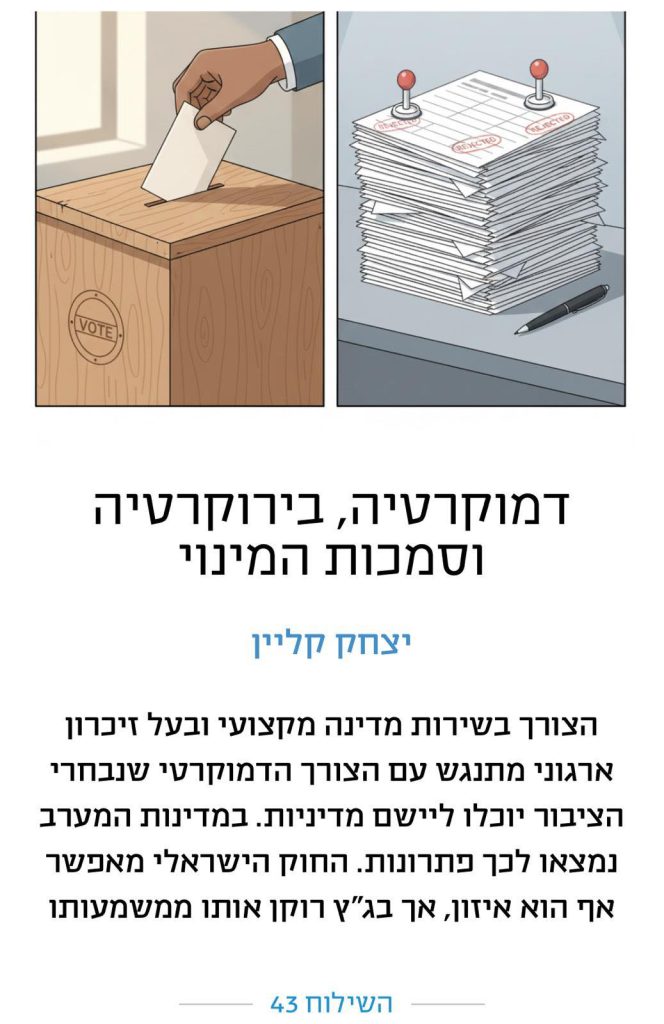

In a comprehensive essay published in Hashiloach quarterly journal, Dr. Yitzhak Klein addresses the issue of how the need for a professional and continuous public service clashes with the democratic necessity for public representatives to dictate policy. Western states have found various solutions, but while Israeli law outlines a balance as well, The High Court of Justice (HCJ) has systematically dismantled that authority by reinterpreting it until the government’s powers were hollowed out.
The authority of appointment is the central authority in any system of governance, as policy is determined by those who direct and implement it. To preserve the democratic principle, which allows for a change in policy by electing different people or parties, the elected representatives must have the authority to actually implement the policy they were voted to implement. Their primary tool for doing so is through the appointments they can make to key roles in government administration.
Modern bureaucracy is a powerful tool for carrying out complex, society-wide tasks uniformly and consistently. It is essential in modern democracies, where authorities are required to act objectively and impartially in an equal manner towards all. However, by its very nature it is contrary to an open democratic society: hierarchal, authoritarian in its management, secretive and closed off to external influence, self-aware and self-interested in preserving its power. Bureaucracies are further compromised by the atrophy that accompanies permanent positions.
Western powers have traditionally seen their bureaucracies as valuable professional tools, and granted them status and independence; however, they have also been aware of their inherent undemocratic nature, especially since the 1950’s, with the advent of public choice theory which identified the issue of how far representatives, or agents, will actually carry out their mission over their own interests.
Various states have developed solutions to balancing between the professionalism and experience required for the bureaucracy with the need to provide elected representatives with the necessary tools for implementing policy:
In the United States, the President, with the Senate’s confirmation, has the authority to appoint the top ranks of the bureaucracy – those positions considered “policymaking positions.”
In Germany, the civil service system balances professionalism with political responsiveness: permanent civil servants can take breaks to enter politics and return afterward, and a portion of senior officials can be replaced when governments change, although the majority stay on to ensure continuity and institutional memory. This creates a blend of stability and political accountability at the top of the bureaucracy.
In France, ministers bring a “cabinet” – a team of approximately twenty staff members for both personal or political roles and professional, managerial ones. Professional civil servants may form part of the cabinet, returning to the civil service at the end of their cabinet tenure. Cabinet members are authorized to issue instructions to the permanent senior ranks, and certain senior appointments in the civil service, independent authorities, and government companies are in the hands of politicians.
In the United Kingdom, the Civil Service Commission is a body intended to be independent of elected politicians and to oversee the recruitment of personnel to the civil service. The original Northcote-Trevelyan model has been modified to allow for more ministerial involvement, such as veto power over the Commission’s candidates, but much of the original zeitgeist remains.
In Israel, the law stipulates that the government appoint the Civil Service Commissioner, that the civil service be professional and apolitical, and free from the influence of politicians over its core composition and structure, as is customary in modern democratic states. The law further establishes the Civil Service Commission to manage the employment of civil servants.
The critical section of the law is Section 23, which empowers the government to determine which positions it wishes to designate as trust-based appointments, where the regular process is circumvented. Most of the positions thus defined as exempt from tender under Section 23 are senior policy-making roles. In 1999, a government decision determined the “procedure” for filling some of the positions created under Section 23: ministers would establish search committees composed of the director-general of their ministry, a representative of the Civil Service Commissioner, and an expert in the relevant field, appointed by the minister with the Commissioner’s consent.
The purpose of using search committees was to help ministers identify candidates with appropriate qualifications. However, since the introduction of the search committee, the legal establishment has been working to erode the authority the government has to make appointments that reflect the ministers’ and government’s point of view.
In 1990, Supreme Court Justice Zamir published a paper calling for the Northcote-Trevelyan model, completely ignoring the extensive research on its shortcomings. Then, in 1996, the Court ruled against an unprofessional appointment, and by the by explicitly referred to his paper and adopted the model as a standard for measuring government activity, further determining that appointments under Section 23 were actually subject to the approval of the Civil Service Commission.
Within the Ministry of Justice, the senior positions in the prosecution and legal advisory system are the Attorney General, the AG’s deputies, and the State Attorney who is subordinate to them. According to government decisions, the appointments to these three positions are made through special search committees composed of five members, three of whom are members of the legal establishment and the Civil Service Commissioner, and only two are appointees of elected officials. Since lately the Civil Service Commissioner has been a weak figure controlled by the legal advisors of the Commission itself, the government has effectively relinquished its appointment authority over three of critical policy-making positions in Israel – positions that also largely determine the government’s scope of power to exercise all of its other powers, including the power of appointment itself.
Another body critical to the implementation of government policy has zero government representation in its composition. The HCJ Department within the State Attorney’s Office – the department that represents the state in proceedings before the HCJ – has a special arrangement with the state by which its members are promoted exclusively from within the department.
A broader campaign to sever the Civil Service Commission from elected officials culminated in a Supreme Court ruling by Justice Yitzhak Amit. Amit ruled that while the government is legally authorized to appoint the Civil Service Commissioner, it must do so through an open, apolitical search committee process – effectively stripping the government of any real influence over who is appointed. In his reasoning, Amit argued that the Commissioner must be free from any political considerations, capable of acting against the government’s interests, and indifferent to its political platform. The practical consequence of this ruling is far-reaching: since the Commissioner plays a gatekeeping role in virtually every senior government appointment, a Commissioner detached from the government’s agenda by design would effectively control all appointments that are nominally in the government’s hands. This transfer of power is not a neutral technocratic reform, but a deliberate shift of authority away from elected officials and toward those who actually control the appointments process.
Bureaucracy is a powerful tool for implementing policy, but in a democracy it is a double-edged sword. By its very nature it fosters a non-democratic culture -hierarchical, closed, secretive, and acutely aware of its own organizational and personal interests. While an effective bureaucracy requires quality appointments and long-term service, it becomes dangerous to democracy if the government cannot establish an “open windows” policy: broad appointment authority at the top of the system where policy is made, and relatively free movement between wider society and the upper and middle ranks of the bureaucracy. The Civil Service Law (Appointments) intentionally left room for Israeli governments to pursue such a policy.
The current extreme situation, where ministers can appoint only two trusted officials, makes effective policy implementation impossible. Legislative amendments are required in at least two areas: anchoring ministers’ authority to appoint a reasonable number of senior advisors and managers as trust-based appointments, and abolishing the arrangement that allows officials to amend or override a government decision to create trust positions under Section 23.
All the necessary tools exist in our laws – what is required is a government that recognizes their importance, a court that does not hollow out the law, and a public informed enough to demand appropriate action.
(See the full essay in Hebrew at Hashiloach quarterly)