Prof. Avraham Diskin
A. The Voting Paradox and the Impossibility of Holding Democratic Elections
My colleague Emmanuel Navon proposed a transition to regional voting by majority in Israel as a solution to the existing problems, as he sees them, with representation and governance. Is he right?
Presumably, the necessity for democratic elections is universally accepted; however, an example introduced at the end of the 18th century proved that it is often difficult to translate individual preferences into a fair arrangement through any sort of voting mechanism. This example was reintroduced in the 20th century, and proved that, in point of fact, democratic elections are impossible:
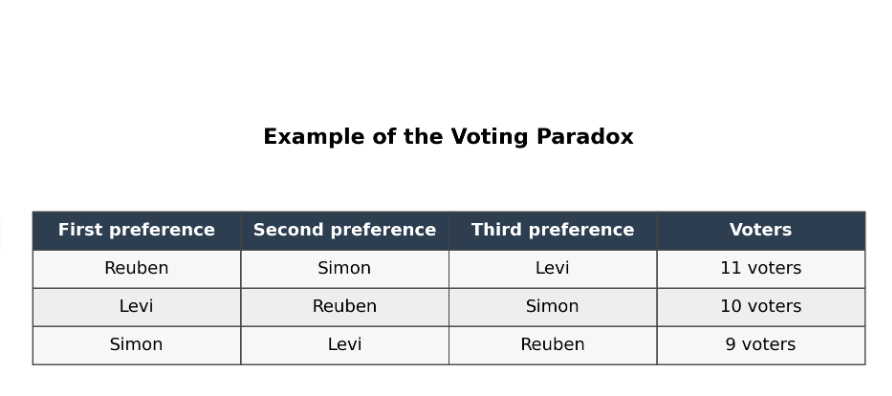
Eleven voters want Reuben elected. Levi is their least preferred candidate, while Simon is considered preferable to Levi, but inferior to Reuben.
Ten voters support Levi’s candidacy. Reuben is this group’s second-best candidate, and Simon their least preferred candidate.
Nine voters would like Simon elected, and do not want Reuben elected. Levi is the middle candidate for these voters.
We assume all voters are consistent, in the sense that if they prefer candidate A over candidate B, and candidate B over candidate C, they also prefer candidate A over candidate C.
It can be argued that in this example, Reuben is the rightful winner, since he has more supporters than the other candidates, despite not enjoying majority support. But if Reuben were elected, Levi can argue that he actually deserves the victory, since nineteen voters (those in the bottom two rows of the table) prefer him over Reuben, while only eleven of Reuben’s supporters have the opposite preference. But if Levi were chosen, Simon could argue that his own supporters, plus Reuben’s supporters, prefer him over Levi – meaning that in a head-to-head matchup, he’d beat Levi twenty to ten. But now Reuben can once again claim priority, since in a head-to-head comparison, twenty-one voters prefer him over Simon. In other words, there emerges a circular order of preference, despite the assumption that every voter is internally consistent in the sense described above.
What is the right way to solve this kind of problem?
The best-known solution was proposed by the same man who first presented the paradox: French nobleman, soldier, and scientist Borda.[1] But Borda’s proposed solution has its own problems, and it doesn’t resolve the objection presented below. [2]
In 1951, the American economist Kenneth Arrow published a well-known book: Social Choice and Individual Values. Arrow, who independently rediscovered the paradox, argued that no democratic decision-making system can resolve this kind of circular-order problem when it arises. In other words, no democratic voting system can avoid this issue if luck isn’t favorable in terms of voter preference. Arrow’s proof is known as the “Impossibility Theorem”. In 1972 he won the Nobel Prize in Economics, largely for this proof, which gave rise to a new field in the social sciences called “Social Choice.”
B. Voting Methods in Democracies
Elections that grant different weight to different voters, or elections that are open to only a limited number of voters are not considered democratic elections. Israeli lawmakers were aware of this, and addressed the issue in Basic Law: the Knesset and other election laws.
One vital principle in democratic voting is the rule of “one man one vote”. In other words, there can be no difference in the weight given to different voters. However, in simple majority-vote elections, supporters of large parties are, in practice, given more weight than others. In regional elections that are not proportionate to the national level, greater weight can be given to voters from certain areas. In the elections to the US Senate, for instance, voters from smaller states have more weight, since all states are represented by two senators.
In the case of parliamentary elections, the electoral system is the method by which seats in parliament are allocated to the various candidates and parties. There are three central questions that determine how seats are allocated:
- Is the election proportional?
- Is the election regional?
- Is the election personal?
The term “proportional elections” means a correspondence between the share of support for the various parties at the national level, and the share of seats each party holds in the elected body. If the country is divided into regions, and proportionality is maintained within each region, then the national result of the election may end up being very disproportional. This deviation grows larger as the number of regions increases and the number of representatives elected in each region decreases. When a party’s percentage of representatives in parliament is similar to the percentage of its supporters in the country as a whole, the election is said to be proportional. It is not possible to maintain full proportionality of results, if only because the number of members of parliament is far smaller than the number of voters.
Some systems also have an electoral threshold, where parties that fail to reach it are not granted representation. There are various formulas for calculating proportionality. Note that election results are sometimes proportional in practice even if the electoral system was not originally designed to maintain proportionality at the national level.
The term “regional elections” means the division of the country into electoral districts, such that the determination of elected representatives is calculated separately for each district. As we will see, there can be electoral systems in which both regional and national allocation calculations are carried out in parallel. Most countries use such district division. Israel is one of the few cases where no such division is used. When there is a division into districts, various questions arise regarding how the districts’ contours are determined,[3] the size of the districts,[4] and so on.
The term “personal elections” means voters can indicate their preferences among different candidates, without this affecting the preference indicated for the party they support. There are countries, though, where it is hard to call the election personal, despite the fact that a candidate’s name appears on the ballot. In the UK, for example, one representative is elected in each electoral district. Voters mark the name of one candidate among the candidates in their district, and the candidate who wins the highest number of votes is elected as the district’s representative. Since each party fields only one candidate in each district, choosing a candidate from a different party would harm the other parties, and in most democratic countries, voters’ loyalty is first and foremost to their party, or to their party’s national leadership. Voting for a candidate of a different party in the electoral district would harm the party the voter supports. Therefore, a party’s single candidate in a district can be seen as a kind of “candidate list” with only one name that the voter cannot alter.
Contrary to Dr. Navon’s starting point, any combination of the three questions raised is possible. There can be proportional elections that are also regional. Regional elections are not necessarily personal. Personal elections can be both proportional and national. Etc. etc.
Let us now turn to a description of various voting systems, to see the wide variety of possibilities in democratic countries.
One of the central criticisms of the British system is the significant distortion of proportionality it is expected to produce. Suppose that in every electoral district, Party A wins 40 percent of the votes, while both Party B and Party C receive only 30 percent of the votes. The British system would award all the seats to Party A. If all districts had an equal number of voters, a national proportional system would give Party A only 40 percent of the seats, and each of the two other parties would receive 30 percent of the seats. Moreover, as already explained, elections under this system are not “personal” in practice.
The distortions of proportionality in Britain are not necessarily hypothetical. In Britain, the third-largest party is always disadvantaged in terms of its representation. Moreover, some supporters of this party, anticipating a result skewed against it, refrain from voting their preference and shift their support to another party. The largest party nearly always wins a majority in parliament, even though it does not have the support of a majority of voters. Many see this as an advantage that offsets the system’s drawbacks, since it prevents the need to form a coalition government.[5]
Some states have districts that send one representative to parliament, but also employ mechanisms to ensure a “decisive majority” of support for the elected candidate. One such mechanism, practiced in France for example, is a second round of elections. If none of the candidates win a sufficient number of legal votes, a second round of votes is held a short time later between the two leading candidates. [6]
Another way to create an artificial majority, one used in Australia, is a voting system known as “the alternative vote”. Australia also practices one-candidate districts, and voters are required to rate all candidates. If none of them attain a majority of the votes, the votes of the less popular candidate are transferred to other candidates according to the second preference of their voters. If at this stage there is still no majority, the votes are transferred once more to the more popular candidates. This process is repeated until one candidate wins a majority.
In Israel, elections are for candidate lists. The parliamentary representation of each candidate list is approximately proportional to the share of its supporters. The first candidates on the list are the ones elected. This is a “rigid list” electoral system, and it clearly contains no elements of regional or personal choice. It is worth noting that there are countries such as Belgium, where voters can propose changes to the order of candidates on the list submitted by the party, thus granting the voting system an element of personal elections. The degree of voters’ actual influence on the structure of the list varies from country to country.
In Germany, every voter has two votes. Half of the representative members are elected in single-member districts, and half according to a national calculation. The first vote cast expresses support for a district representative. The second vote expresses support for a party. The allocation of district seats is done similarly to the British system. But the allocation of party votes is done so that each party receives appropriate proportional representation out of all the seats in parliament. This produces a system that is both regional and nationally proportional. Although the regional portion of the German election is determined using the British method, the election is personal, unlike in the British case, because voters can support a candidate from a different party without harming the overall representation of the party they favor. [7] The German system is called the “mixed system”. There are other ways to achieve proportional national representation, even if all members are chosen within electoral districts.
C. “Majority Rule” and “Tyranny of the Majority”
The idea of competitive elections, which serves as a central touchstone for the existence of a democratic regime, is connected to another central concept: “majority rule”. Ostensibly, it is self-evident that in a democratic regime, the majority makes the decisions – clearly, a regime deliberately designed to concentrate power in the hands of a minority is not a proper democratic regime. However, the claim that majority rule is an essential characteristic of a democratic regime is problematic in at least three respects: the ambiguity of the concept of “majority,” the difficulty of achieving a majority, and the problem of the “tyranny of the majority.”
The Difficulty of Obtaining a Majority:
As we’ve seen, it is often difficult to achieve a majority among the public, or among members of a deciding body. Even when there are only two alternatives between which the voters or the representatives are supposed to decide, it is possible that, due to abstention or absence on the part of some eligible voters, an absolute majority among the franchise will not be achieved. We have also seen that under the simple plurality electoral system, adherence to a decision by simple plurality often produces an artificial majority in parliament, one that most voters actually oppose. Moreover, the voting paradox demonstrates that at times, there is not only no majority, but it is difficult to reach a democratic decision under any electoral system at all.
The attempt to artificially create a majority may produce a result in which the winner is supported by a minority, while a larger group of citizens prefers a different alternative. In certain electoral systems, such a result can occur even if the real contest is only between two alternatives or two candidates. [8] Nevertheless, all democratic electoral systems are, in practice, competitive. They allow for changes of government, and an attempt is made to ensure majority rule.
Tyranny of the Majority:
In addition to the problem of achieving a majority, or the even more complex problem of achieving an artificial majority, there arises the issue of the “tyranny of the majority”. Even a lawfully-achieved majority can abuse the power it holds. Such a majority can act oppressively toward various minorities or toward individuals within the population. In every democracy, even one in which a proper majority has been achieved, there is a need to take measures to restrain the majority. This restraint concerns citizens’ fundamental rights, minority rights, and the measures adopted in the constitution.
Democratic government aspires to express the will of the majority. But at the same time, majority rule must also be subject to appropriate values. The tension between the supremacy of the majority and the supremacy of values is reflected in the Biblical phrase “to incline after the many” and in its interpretation. The accepted meaning is that in the case of a dispute, the majority decides, but if the majority is “inclined toward evil,” it should not be followed.
Some believe that, due to both both the problem of achieving a majority and the problem of “tyranny of the majority,” democratic regimes ought to use measures that actually reduce the chance of achieving a majority. One such measure is the use of proportional elections.
Voting Systems and Societies
The Dutch-American political scientist Arend Lijphart held that voting systems and other governance mechanisms should be adapted to the type of society they serve. For example, in homogenous countries, i.e., those without significant minorities, majority democracy can and should be used, including election systems that guarantee the creation of a majority, even an artificial parliamentary one. However, in deeply divided countries with multiple minority groups, like Israel, such systems may lead to a tyranny of the majority. Therefore fractured countries should use proportional voting systems that prevent the creation of an artificial majority. It is further advisable for such societies to employ additional means to reach a “consensus democracy”, such as coalition governments.
Majority democracies exercise the principle of majority rule, while consensus democracies resolve contentious issues by an attempt to reach agreement between the various clashing parties.
____________________________
All information herein is drawn from the book, Government and Politics in Israel: Principles of Citizenship (Hebrew), published in 2011.
[1] Jean Charles Chevalier de Borda. He presented a parallel problem to the Royal French Academy of Science in 1770. A written report of the problem was supplied only in 1784 by another eminent scholar, Marie-Jean-Antoine Marquis de-Condorcet.
[2] Borda’s solution was to grant one point to the least preferred candidate, two to the second and three to the first. The total amount of points each amassed would determine the winner. Under this method, a candidate no one wanted as a first preference may prevail over a candidate who has a majority of support. Despite this, Borda’s method was recently revisited due to the work of the American scientist Donald Saari. Condorcet offered his own solution (which isn’t relevant to this example) – a candidate who beats all others in head-to-head contests, should be the rightful winner. Such winners are known as “Condorcet winners”. Suppose 50 voters want Candidate A, and their second preference is Candidate B. 50 voters want Candidate C, and also prefer Candidate B as their second choice. Suppose Candidate B is supported by a single voter. He will still be the Condorcet winner because he would win against the others by 51-50.
[3] One of the primary concerns is artificial determination of voting regions in a way that intentionally distorts election results. In the 1812 US elections, Elbridge Gerry was voted in as James Madison’s Vice President. Gerry became known as the source for the word “gerrymandering”, due to the distorted division of voting districts imposed by the 1812 Massachusetts administration shortly before his appointment as VP. The press raised the (doubtful) claim that Governor Gerry, eager to be reelected governor, designed one of the electoral districts in the shape of a salamander. In fact, Gerry refused to sign off on changing the electoral districting for a long time. The concept of “gerrymandering” points to an acute problem with dividing the country into electoral districts, since it is always possible to design them in a way that influences results. Such a distortion is possible even when the number of eligible voters in each district are mandated to be proportionate to the number of voters in the area, and even when requiring all districts be geographically contiguous. Today, certain geographical software designed to create such distortions exists. It must be borne in mind that such possibilities always exist because of the frequent connection between voters’ residence and voting patterns.
[4] For example, districts can be of a uniform size or varied. In the US, for instance, two seats are granted to all states in Senate elections, while each state gets a different number of representatives for the House according to the number of their eligible voters. Obviously the Senate elections are purposely slanted in favor of the smaller states.
[5] Still, in the 2010 elections no party won a majority of seats in the British Parliament and the largest party (the Conservatives) formed a coalition with the third-largest party (the Liberal-Democrats). In 1974, the UK held two elections, as no party won a majority of seats in the first.
[6] Israel employs a similar method in mayoral elections, when no candidate wins 40% of the valid votes. As illustrated by the aforementioned example, often, the “Condorcet winner”, considered the appropriate winner by most of the literature, would not even participate in the second round. For instance, in the UK’s last elections, the Liberal-Democrat party was the Condorcet winner, but the British voting system cheated it of such victory. The “French” solution would be of no help. An interesting collaborative article on this issue is forthcoming in the Electoral Studies journal.
[7] In all the elections conducted according to this method, practiced since 1949, less than one tenth of German voters chose to split their vote in such a way. This finding testifies to the fact that preference is given first and foremost to the party rather than individual candidates.
[8] In the US, the President is elected by the electoral college. Each state is allocated a number of electors in the college (identical to the number of its representatives in the House and Senate, with the unrepresented District of Columbia granted three extra electors). In the vast majority of states, the candidate who won the majority of votes in the state wins all its electors. This result leads to severe proportionality distortions. It has happened that a candidate who won less votes won more electors and was thus elected. In 2000, a serious dispute arose over the vote count in two states. Ultimately, Republican candidate George Bush won thanks to the 271 electors who supported him compared to the 266 who supported his rival Al Gore, despite the fact that Gore won by over half a million votes. Other clear cases of presidential candidates winning more votes and losing the election occurred in 1824, 1876 and 1888.