By: David M. Weinberg
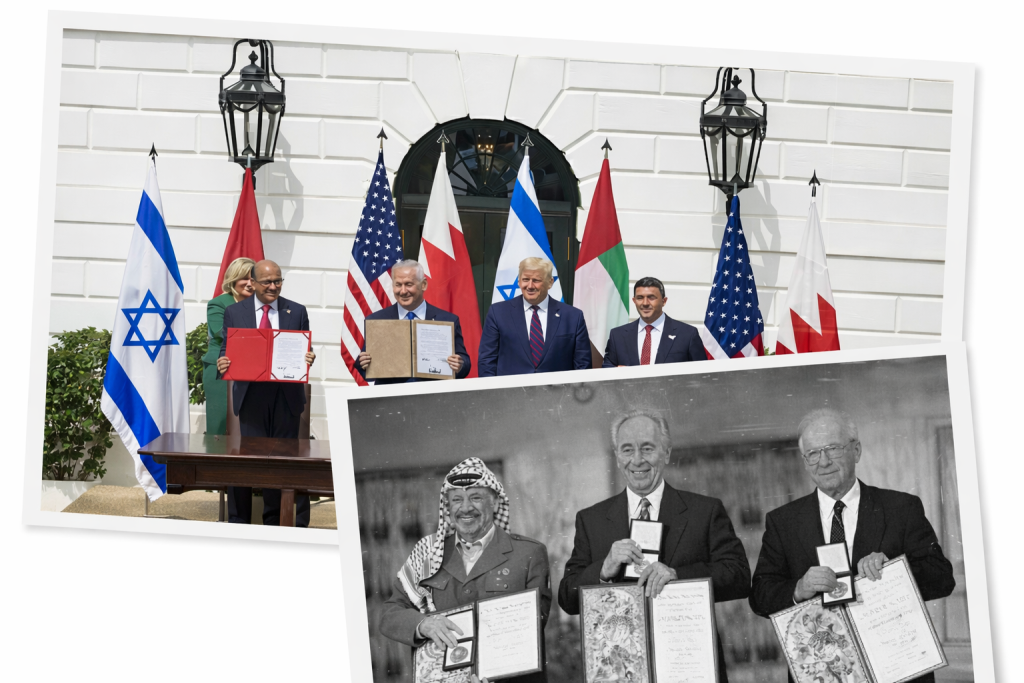
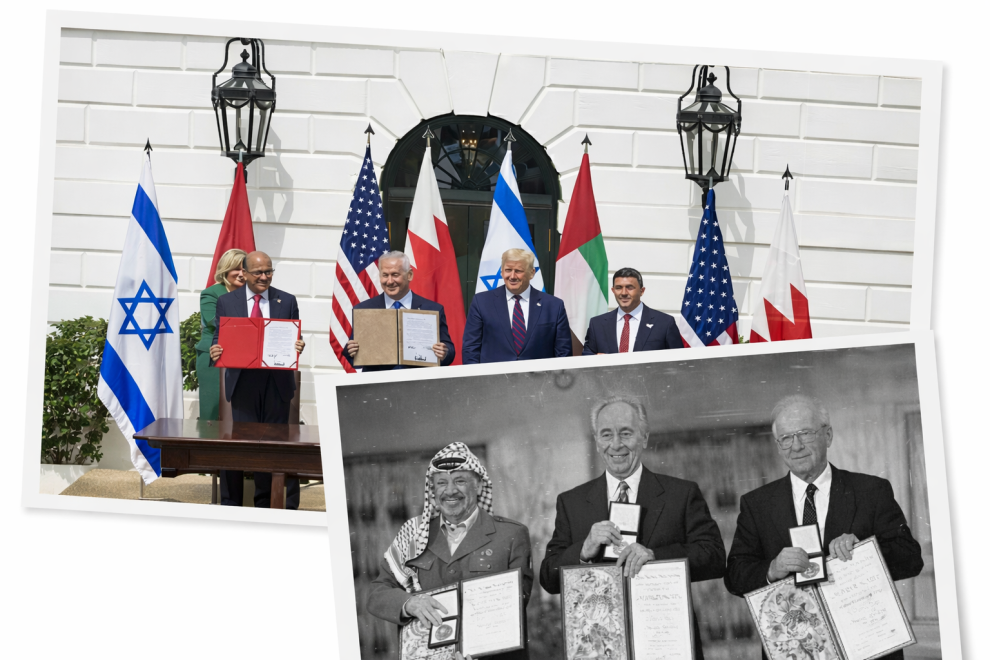
The nearly forty years of Oslo-style arrangements, under which the West enticed Israel into territorial concessions and put pressure on the country to show restraint in the face of emerging threats, have proved to be an utter failure. The policy of “containment”, which favored diplomacy over decisive military victories against jihadist adversaries, has failed. These approaches blew up in the State of Israel’s face with terror attacks from Judea and Samaria, the Gaza Strip, Syria and Lebanon, and with the advancement of Iran’s nuclear bomb program to near completion.
Over the past twenty-four months, Israel has out of necessity shifted toward a better balance between diplomacy and the use of force in thwarting enemy threats. In order to establish dominance along its borders and strategic superiority against more distant threats, Israel has moved towards “regional power thinking”; towards proactive action. Israel must – and will continue to – carry out aggressive and overwhelming surprise strikes against enemy strongholds, from Khan Yunis to Isfahan. Israel needs to keep its enemies in constant dread of exploding pagers and bunker-penetrating airstrikes.
Israel intends to be militarily intimidating and dominant – even an unpopular “hegemon.” It knows that its neighbors will seek genuine reconciliation only when it is strong. Therefore, Israel can no longer accept policies that emphasize “quiet for quiet” and “restraint,” because these allow their enemies time and space to regroup – something Western officials mistakenly call periods of “stability.”
In this new era, Israel proposes to project its power in order to neutralize its adversaries. It intends to truly “stabilize” the region – and not rely on flawed diplomatic templates and failed formulas that signal weakness. All of this is grounded in a clear strategic outlook that stems from a realistic perception of the region. Israelis and their leaders understand that the rules of the game by which our adversaries operate are based on prolonged wars of attrition, guided by an ethos of sacrifice and eschatological visions of fanatical and crushing victory.
Therefore, for example, Israelis understand that beyond any security agreements that might be made with the new regime in Syria (headed by the Sunni jihadist Ahmed al-Sharaa) or with the Aoun government in Lebanon, the IDF must routinely thwart threats to Israel emanating from within these countries – and will continue to do so. Israel will not, as it did in the past, sit quietly for a decade or two merely gathering intelligence on emerging threats, until they reach monstrous proportions.
This means that Israel will intervene to some degree on behalf of the non-jihadist Druze community in Syria, which holds a strategically important area in the southeast of the country, along Israel’s northern border. That is what a world power would do. Israel will not wait for American mediators to settle the situation, nor rely on UN forces to protect the Druze and secure the border, nor will it refrain from striking al-Sharaa’s assets simply because Europe is reinvesting in Syria.
The same applies to Judea and Samaria. No one is under any illusion that a Palestinian “Authority” of some sort can or will block the Iran-backed Islamic terrorist forces in the areas under its control, forces that directly threaten Jerusalem and the country’s Central region. Only the IDF can and will. That is why we’re witnessing intensive military operations in Jenin, Tulkarm, and Nablus, aimed at decisively uprooting such threats. This will likely become a permanent pattern of IDF operations.
Incidentally, Israel has no confidence whatsoever in the ability of the European Union or the United States to bring about meaningful reforms within the Palestinian Authority (PA), such that would turn it into a “democratic, transparent, efficient, and sustainable governance system”, as the EU declares.
After investing thirty years and billions of dollars and euros in the PA, the returns for the West are abysmal. There is no democracy, no rule of law, no transparency, no sustainability, no investment in economic stability and no education for peace. There is only nepotism and corruption; reward for and encouragement of terrorism; violent propaganda against Israel, including support for the October 7 massacre; and attacks on Israel in every possible international forum. Moreover, in more than thirty years, not even one new hospital was built in the PA’s territory with European funds, and only one wastewater treatment facility has been constructed.
As for the security funding (particularly American) that was invested in the PA, more than one billion dollars have been spent on training PA security forces, with more than 40 million dollars of that in 2025 alone. The results are mixed at best. PA security personnel have repeatedly assisted or even participated in attacks against Israeli civilians and IDF soldiers. Approximately 12% of all terrorists detained in Israel are PA security personnel.
The renewed revival of illusions in France and Saudi Arabia regarding a Palestinian state is an utterly senseless act, especially now. It is a recipe for devastating disappointment and an escalation of the conflict – and, of course, the isolation of Israel. Perhaps that is the purpose of the French-Saudi exercise: to weaken Israel, to prevent it from becoming too strong or too “hegemonic” in its ambitions, too “aggressive” in its military operations, and too “dominant” in redefining the regional strategic situation, and to prevent it from succeeding too well in defending itself, which would include preventing the establishment of an unrestrained Palestinian state.
According to French President Macron, Israel must not win by too much, especially following its successful strike on Iran’s nuclear program. In his view, Israel needs to be restrained, hemmed in, and humiliated. “There is nothing to discuss,” he pompously declared last summer regarding the “urgent need to recognize” a Palestinian state. It “must” happen, Macron announced – despite Israeli opposition, and if necessary, over the bodies of murdered Israelis.
The same is true of the situation in Gaza. Israel must act as a hegemon to eliminate the military threat from Gaza and ensure the revival of the Negev. This means that beyond the agreement that brought the release of the living and deceased hostages, there can be no long-term arrangements with Hamas. The terror organization must be eradicated from Gaza. There absolutely must not be any reconstruction in the Gaza Strip without its complete disarmament. This probably means another decade or so of varying degrees of military engagement, despite agreements brokered by the US and its Arab partners to “stabilize” Gaza.
There can be no expectation that Israel rely on Egypt or any other Arab state – not to mention UN forces – to bring security or stability to Gaza. Egypt has ignored the massive weapons trafficking from the Sinai to the Strip for years, and of course did nothing back when Hamas rose up and violently replaced the PA government, turning Gaza into a Muslim Brotherhood mini-state. Israel will also not consent to a Palestinian “technocrat” government in Gaza, which would only be a thin veneer over actual Hamas rule.
Israel’s new mindset, in which it views itself as a regional power, applies of course to Iran as well. It is imperative to prevent the reconstruction of Iran’s nuclear program and the development of its ballistic missile array, and Iran must be deterred from rebuilding its proxy network across the Middle East. Any new “cosmetic” agreement between Iran and the West on these issues will compel Israel to act once again against Tehran. Israel will apply its updated defense doctrine – its regional power strategy – to swiftly neutralize enemy capabilities.
Israel intends to continue maintaining its superiority, with the regional power mindset described above, and to act as a proactive regional force – the only true Western ally – reshaping the Middle East for the better. To all representatives of the old and weak diplomatic establishment who begrudge Israel its strength: Get used to it! Get used to the new strategic reality, anchored by a powerful Israel.
David Weinberg is co-Director and Senior Fellow at the Misgav Institute for National Security & Zionist Strategy in Jerusalem. The opinions expressed here are his own. Thirty years of his writing on diplomacy and defense are available here: https://davidmweinberg.com .