From Cotton to Crude: Defending the “War-Sustaining” Doctrine as the Modern Standard of Global Warfare
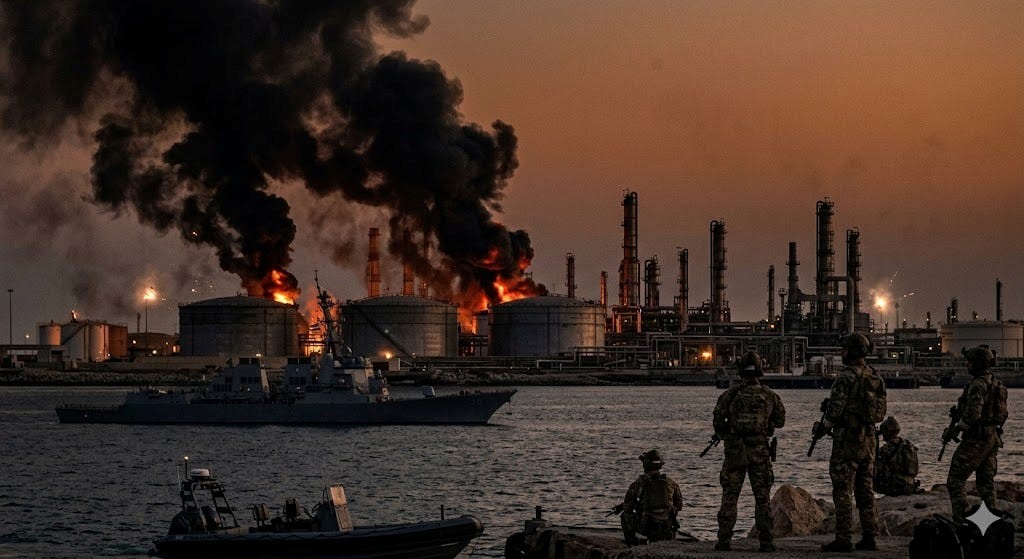
In the recent war with Iran, there has been much controversy surrounding the United States’ attack on Iranian oil refineries. Many critics accuse the United States of ignoring the “Rule of Distinction” central to the Law of Armed Conflict. Just like there is a law to distinguish between civilians and combatants in military strikes, there’s also a law to distinguish between civilian objects and objects that contribute to the enemy war effort. Art. 52 of AP I of the Fourth Geneva Convention limits attacks to objects whose “nature, location, purpose, or use makes an effective contribution to military action, and whose total or partial destruction, capture or neutralization, in the circumstances ruling at the time, offers a definite military advantage”.
This category remains ambiguous, however, regarding how directly the objects’ contribution to the war effort needs to be. Does the target need to relate directly to the supply of weapons and ammunition to be legitimate, or does it suffice that the target is crucial to the enemy’s economy, which is vital for maintaining hostilities? The United States follows a broader interpretation of Art. 52, not limiting legitimate targets to those which provide “war-fighting capabilities”, rather including targets which provide “war-sustaining capabilities”, which mainly include economic targets, such as a country’s natural resources, crops, power stations, and financial institutions. These objects are also referred to as “dual-use objects”. The practice of targeting these objects dates back to the American Civil War, when Union troops burned Confederate cotton fields because the sale of cotton provided for the vast majority of funds for their arms and ammunition [Dinstein, The Conduct of Hostilities under the Law of International Armed Conflict, pg. 40].
The US position can be traced back to the 1987 Navy manual called “The Commander’s Handbook on the Law of Naval Operations”. The Handbook interpreted Art. 52 of AP I to include objects whose “nature, location, purpose, or use, effectively contribute to the enemy’s war-fighting or war-sustaining capabilities”. This addition was echoed in Congress in 2006 with the passing of the Military Commissions Act. The most current expression of the US position is the 2015 Department of Defense Law of War Manual. While at first glance it seems to quote Art. 52 verbatim by referring to a “direct military advantage”, it later defines that to include “war-fighting or war-sustaining capabilities”. Critics of this broad definition respond, however, that it doesn’t do justice to the term “effective contribution”, as an indirect contribution is not as effective as a direct one. Critics also infer from the need for a “definite military advantage” that it cannot merely contribute to the overall war effort, rather each attack specifically needs to have direct military objectives. Furthermore, critics are concerned that adopting such a permissive approach would undermine the necessary protection of civilian infrastructure that Art. 52 intended to provide.
In this article, I set out in order to prove that the US position regarding the Article’s interpretation is the correct one, despite its’ inherent ambiguity, using an argument from State Practice, which is the basis for International Law. Despite the current controversy, I would like to claim that the majority of states have in practice accepted the broad interpretation, as revealed by their actions both before and after the drafting of AP I, and throughout the history of modern warfare.
Following the above-mentioned attack on Confederate Cotton fields, when the Law of Armed Conflict was in its infancy, there was a joint American-British Claims Commission which ruled that the capture and destruction of these fields was even more crucial to the war effort than the targeting of enemy munitions(!). The following major development, which would bring warfare to the modern era and exponentially raise the scale of potential destruction, was the invention of the airplane and its use as a weapon of war. The “Strategic Bombardment Theory” emerged during World War I, based on the rationale that aerial attacks should focus on the enemy’s economic infrastructure. The United States and Great Britain made extensive use of this strategy against Germany’s “root industries”, such as factories and the like. The Allies continued with this approach throughout WWII, targeting German aircraft production facilities, transportation networks, oil facilities, and other war-sustaining industries. One major example of this was “Operation Tidal Wave”, where 178 bombers destroyed Nazi oil fields in Romania.
State Practice didn’t change following WWII, and it wasn’t limited to the United States or the United Kingdom. The UN International Force deployed during the Korean War attacked rice fields because the rice was sold to fund arms production (similar to the attack on Confederate Cotton Fields during the Civil War). Similarly, during the Vietnam War, “Operation Rolling Thunder” was launched against the petroleum, oil, and lubricant stations, as well as power stations and other crucial industries in Hanoi and Haiphong. One crucial development to examine is NATO’s 1999 intervention in Kosovo, known as “Operation Allied Force”. Initially, NATO forces stuck with the narrow interpretation of Art. 52, and only targeted objects that provided “war-fighting” abilities. However, when the campaign proved ineffective in stopping Yugoslavian President Slobodan Milosevic from ethnically cleansing Kosovar Albanians, the NATO forces widened their list of acceptable targets to include “war-sustaining” economic targets.
The State Practice accepting the broad interpretation continued into the 21st Century. In 2005, in the aftermath of the Ethiopia-Eritrea War (1998-2000), a Claims Commission was established in The Hague to adjudicate damages incurred during the conflict. Regarding the destruction of an Eritrean Power Station, the Commission decided that the target was legitimate for two reasons: Firstly, it was in fact a military objective because electric power stations are generally seen as an effective contribution to military action since they supply power for communication, transport, and industry to fuel the war effort (despite the Eritrean Military having its’ own power stations). Secondly, “the infliction of economic losses… is a lawful means of achieving a definite military advantage“. The clearest example, however, that general State Practice resembles that of the US, is the war conducted against the Islamic State in Iraq and Syria. By August 2016, there was a coalition of 26 states fighting the Islamic State, including the United States, the United Kingdom, Turkey, Jordan, the Netherlands, France, Denmark, Bahrain, and Australia. The coalition carried out extensive bombing raids against the Islamic State’s oil industry, as well as its’ financial institutions. This move was backed by a United Nations Security Council Resolution on December 17th, 2015, which called its members to “prevent and suppress” the funding of terror through the sale of oil, according to the Law of Armed Conflict.
Despite the clear State Practice which favors a liberal interpretation of the category “effective contribution to a military action” in Art. 52, there is still a concern that this interpretation will give states total carte blanche, turning the Rule of Distinction into a dead letter. Critics of this approach have a legitimate concern, as the whole point of Art. 52 was to protect civilian infrastructure. Furthermore, there are concerns that attacks on civilian infrastructure will strain the Rule of Proportionality and increase civilian deaths. US Air Force Major, Israel D. King, gives multiple alternative solutions that allow for a balanced approach. One potential solution to this issue, is if States take upon themselves to set criteria of when they will attack civilian infrastructure and when they will not. For example, a State can declare that it will attack only if an enemy’s power station or oil plant is “indispensable and principle” for the funding of the war effort, and taking out that target would significantly cripple the enemy (the official position of the United States). Another option would be to only attack civilian infrastructure that can be directly linked to the supply of a specific component in the enemy war machine.
Another potential solution that would mitigate the harm to civilians in the event a “dual-use” object is targeted is factoring in the damage to the object itself while factoring in proportionality. While factoring the Proportionality of an attack, AP I requires belligerents to factor in the “loss of civilian life, injury to civilians, [and] damage to civilian objects.” There is debate over which types of civilian objects the law refers to. Does it include the “dual-use” object, or is it only referring to other objects which are purely for civilian use? To allay critics’ concerns, the US can adopt a stricter approach that requires the attacker to consider the attack’s effect on the object itself and its ability to serve the civilian population. If the damage to the civilian infrastructure is disproportionate compared to the military advantage to be gained from attacking the object, this should be reason to call off the attack. An attacking state should also take into account reverberating effects immediately following an attack, as well as its cumulative harm to communities in the long term. For example, a belligerent should take into account whether or not the destruction of a bridge would stop civilians from going to work or receiving essential medical care (such as in the ICTY Trial Chamber Judgement, Prosecutor v. Prlic).
In conclusion, I believe that the United States’ position regarding “war-sustaining” or “dual-use” objects is the correct one. Despite the ambiguous language of AP I Art. 52, “a definite military advantage” surely includes economic targets, such as the Iranian Oil fields in the current conflict. In order to allay critics’ concerns, the United States should be careful to attack only economic targets that are crucial to the war effort and whose military benefit can be directly traced. Furthermore, the United States should consider the overall effects of the object’s destruction when assessing the Proportionality of the attack.