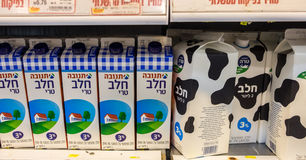
It’s hard to think of a greater inversion of the facts than former MK Inbar Bazak’s column, titled accusatorily “The Connection Between Milk Shortages and Kohelet Forum”. Filled with lies, inaccuracies and rehashed arguments, Bazak’s column takes issue with the agricultural reform that went into effect on July 2022, which, according to her, caused shortages of products and undermined food security without lowering prices.
Is that really so?
To begin with, the reform led by Minister of Agriculture Oded Forer to which she alludes was a courageous and important step in the right direction, but had no impact on the dairy industry, rendering her central claim attributing the shortage to the reform or to Kohelet Forum nonsensical. This alone would suffice, but having opened the issue to discussion, it would be well to remind everyone of the true cause of milk shortages: central planning.
A simple Google search will reveal annual reports of milk shortages prior to the Jewish New Year holidays, long before anyone considered agricultural reform. For decades, Israel’s dairy industry has been subject to strict planning by The Israel Dairy Board, through which the state determines how much milk will be produced, who will produce it, and at what price it will be sold to dairies and consumers. The current system sets the minimum price paid to dairy farms and the maximum price for milk sale, thus incentivizing the dairies – primarily the Tnuva company which holds the lion’s share of the market – to avoid producing regular milk at times of high demand. Add to that the fact that the holidays follow the summer, when demand for milk is high at the same time as bovine milk production decreases, and the seasonal milk shortage is understandable. Many countries solve the issue of higher milk production in the winter by manufacturing milk powder from the surplus. In Israel, however, this product also carries a high tariff of 212%, with the import quota exempt from tariff only recently revised upwards because of a shortage; of course only temporarily.
Another result of the comprehensive central planning, aside from the annual New Year shortages, is milk prices among the highest in the developed world. The Comptroller’s 2023 report revealed a disparity of 77% between Israel and the EU: while the average price of a liter of milk in the EU was close to a dollar (3.5 shekels that year), the price in Israel was 1.8 dollars.
Another claim made in the column is that opening the market to importation will not lower prices. As an example, Bazak states, without supporting data, that lifting trade barriers on the fish market caused the closure of fish-farming ponds and “long term price hikes”. In fact, the fish import reform (removing quotas in 2016 and 2022) was among the most effective in Israeli food products. From 2015 until today, frozen fish prices dropped 8.3% while other foodstuffs rose by 22.2%. If not for the cancelation of quotas on other food products as well, the hike would be even steeper. Many of us surely still remember that the price of pineapples hovered, until recently, around fifty shekels for a single item, dropping precipitously to 10 shekels per kilo after importation from Costa Rica was permitted.
A claim raised by the agricultural lobby and repeated in the column is that since Israel is an “island country” surrounded by enemies, it must rely on local production to ensure food security. Contrary to the connection between competition and lowering prices that seems obvious to most, concern for food security may sound like a good counter argument, one strengthened by the Ministry of Agriculture’s name change to “The Ministry of Agriculture and Food Security” around a year ago.
Nevertheless, this justification is absurd: First, farmers themselves are dependent on importation for animal feed, corn, seed, fertilizer and agricultural machinery. Secondly, Israel does not have the capability to provide all agricultural produce and imports food products – even ones it restricts (such as the aforementioned milk powder).
The most preposterous argument is that the state must guarantee farmers a market, since agriculture requires time and investment. In reality, nearly every entrepreneur invests time and capital with no security – high-tech entrepreneurs develop products for years with no assurance of a buyer, restaurateurs open a business without knowing what their future income will look like and so too do contractors and industrialists. Such a demand could only come from an industry grown accustomed for years to a special cartel.
Instead of protecting agricultural cartels with baseless arguments, it is time to embrace, alongside direct subsidy of farmers where necessary, true competition that will lower food prices for consumers.
(First published in Hebrew on WallaNews)