

Prof. Abraham Diskin
In contrast to the many fears of populism and short-sightedness of direct democracy based on polls, it seems that sometimes the system works pretty well.
For many years, I believed devoutly in the idea of representative democracy and feared the problematic use of direct democracy. Today I am less adamant, due in part to the research I conducted with two colleagues, Andre Eshet – Schwartz and Dan Felzenthal, analysing the referendums in Switzerland.
Swiss society is radically divided: it consists of twenty-six cantons, with German the predominant language in nineteen of them; French the majority language in six, and Italian the common language in the last; fourteen cantons are majority Catholic while the other cantons are majority Protestant. Despite this, the country enjoys impressive political stability. In 1959, four major parties formed a coalition according to the so-called “magic formula”. Since then to this day, the same coalition controls Switzerland, with each of the seven members of government serving as prime minister for one year.
The first all-national referendum took place in Switzerland in 1848, and has been held more than five hundred times since, a number exceeding national referendums conducted in all other states combined. A statistical review of the polls proved that their existence reflects homogeneous behavior despite linguistic, religious and political divisions. In general, it can be said that the way people vote in a French- language canton will be very similar to a vote in a German-language one.
But the Swiss example is not guaranteed in other contexts. The referendum held in 1950 in Belgium, where citizens were asked to approve the return of King Leopold the 3rd to his throne, highlighted the rift between the Flemings and Walloons, which wasn’t so apparent before the referendum. The referendum was a catalyst to the process that now threatens the very existence of Belgium continuing as a united country. Unlike Switzerland, there are countries that do not have national referendums at all. A clear example is the United States, although some U.S. states hold referendums routinely, notably the most populous one in the U.S. – California.
In some countries, referendums are held only on cardinal issues, mainly on matters concerning state sovereignty or major constitutional questions. Britain, for example, has held only two nationwide referendums. In 1975 the question was whether Britain should join what was then called the “European Community.” In 2011 the question was whether Britain should change its electoral system. Nine other referendums held in Britain took place only in part of the kingdom – in Scotland, Northern Ireland, or Wales. Referendums in Britain are “binding.” But even in countries where referendums are “advisory,” the state takes the results into account. Norway’s accession to the European Community was rejected in the early 1970s despite the government’s position, because opponents won by a slim majority in an advisory referendum.
The Dilemmas of Mill and Rousseau
These findings led me to wonder if some of the criticism and concerns regarding direct democracy have simply not materialized, chief among them the concern that direct democracy would inevitably lead to partisan decisions made for short-term gains.
The father of “representative democracy”, as substantially distinguished from “direct democracy” was John Stuart Mill, who expounded on his views in his book Considerations on Representative Government, published in 1861.
The philosopher Mill, whose father was a philosopher as well, is one of the most prominent liberal and utilitarian thinkers. He thought that a government acting in its citizens’ interest must improve citizens’ good qualities and promote the common good as much as possible, beyond the immediate term. Mill placed the long-term common good as the supreme goal, and believed that direct democracy, in which citizens make decisions “from today to tomorrow”, would promote short-term egocentric and group interests at the expense of favoring the long-term benefit of society as a whole.
Jean-Jacques Rousseau had already addressed this dilemma in his book On the Social Contract, published 99 years before Mill’s book. Rousseau distinguished between “the will of all” and “the general will”: the difference between these two lies at the heart of his opposition to direct democracy, and Rousseau emphasized it to such an extent that some have argued his work gave rise to both democracy and the harshest modern totalitarian regimes.
For a public of people waiting for a bus, the general will reflecting the public good is to maintain an orderly line and act accordingly. Under regular conditions, such behavior serves both the general public as well as each of the individuals. However, the “will of all” may be reflected in each wanting – and trying – to get ahead in the line. Such behavior could result in a general brawl, ultimately leading to a loss for all parties involved. Therefore, strong rule is required. Mill thought that such government must be one of representatives, who won its voters’ trust or could be punished by them at periodic elections. Only such a government could focus on realizing the “general will” and not blindly follow the destructive “will of all”.
What About Israel?
It seems that the British example of holding referendums on matters of sovereignty and major constitutional issues should not be rejected outright. Some argue that the laws enacted in Israel on referendums were intended to establish an additional barrier to relinquishing Israeli territory [in a potential peace agreement]. Nevertheless, it should be emphasized that whenever an Israeli government made a dramatic decision regarding foreign affairs and security, it had, according to public opinion polls, public support – even when the public’s position had previously been different. This pattern applies both to left-wing and right-wing governments, and to both hawkish and dovish decisions.
The support for holding a referendum, among both Jews and Arabs, is reflected in the monthly “Peace Index” poll for July, published by Tel Aviv University and the Israel Democracy Institute (see image below). There appears to be a chance that referendums on
questions of diplomatic arrangements would actually strengthen the government.
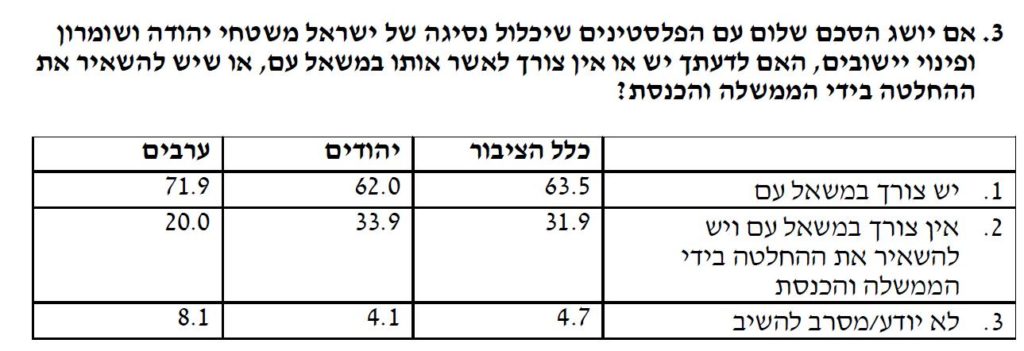
(Survey question: Should a peace agreement with Palestinians that includes an Israeli withdrawal from the territory of Judea and Samaria and the dismantling of settlements be reached, is it your opinion that such should be ratified by a referendum or should the decision be left to the government and Knesset? Row No.1 shows “Yes”, No.2 “No” and No. 3 “Don’t know or refuse to answer”; the first column shows the response from the general public and the next two look at Jews and Arabs, respectively).
(First published in Hebrew at Mida)