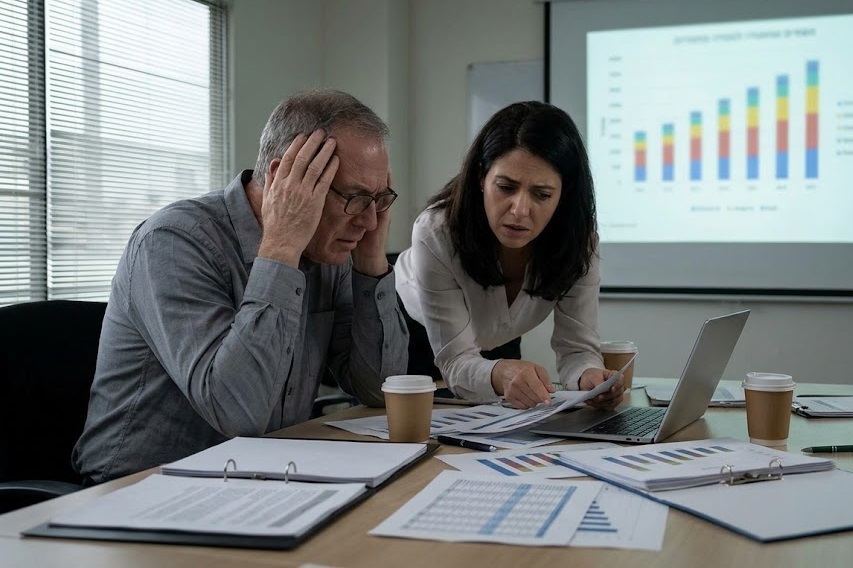
This week saw the publication of Prof. Ami Moyal’s report on testing in the education system, revealing a deep crisis of trust and a sense of alienation between RAMA (the National Authority for Measurement and Evaluation in Education) and the Ministry of Education, resulting in a lack of cooperation. The report brought to light disputes along the entire process – from the way the tests are administered and how their results are interpreted, through an excessive delay in receiving the results, and ending with blocking Ministry headquarters, supervisors, and school principals’ from accessing raw data. Instead of serving as a pedagogical tool, measurement has become a battlefield, and it is the students who pay the price.
To repair the system, the Moyal report recommended a comprehensive organizational overhaul, many components of which were delineated in the Kohelet paper “Clearing the Fog: A Comparative View of Evaluation and Assessment in the Israeli Education System”. Among the Moyal recommendations are:
- Anchoring RAMA’s status in a “RAMA Law.”
- Establishing a national council for measurement policy.
- Setting a stable, multi-year policy that will make it possible to identify and diagnose trends.
- Transitioning to digital testing, and providing raw data and tailored reports to Ministry leadership and school staff more openly than at present.
It is precisely against the backdrop of these recommendations that Education Minister Yoav Kisch’s decision to cancel the national tests once again – following last year’s cancellation of the sixth-grade tests and the Hebrew exam for Arabic speakers – is deeply regrettable. The policy of cancellations does not solve the problem; it makes it worse. The answer to testing failures is not to break the compass and make the tests disappear, but to fix the issues. When Israeli students’ achievements on international tests are in continued decline, the avoidance of internal measurement prevents the identification of failures and real time responses.
The problem starts with the fact that it is the Israeli government who should be the recipient of the report, not the Education Minister, because the first change required is removing RAMA from the Education Minister’s authority and legally anchoring its status and its obligations to both the Ministry and the general public. Currently, “the cat is guarding the cream”, and it is easy for the Minister to cancel tests that also measure how successful he has been.
In our view, the evaluation system needs an even deeper structural reform. The Kohelet study recommends four essential steps for improving the system to measure students’ achievements:
1. Abolish the tests’ anonymity, and track each student individually: The Moyal report proposed examining this issue. We believe that anonymous tests undermine students’ motivation to succeed on the test, and prevent the individual tracking of each student’s progress. Annual, individual longitudinal tests (grades 1–9) should be held in core curriculum subjects, and support provided where findings show it necessary.
2. Accountability and transparency at the end of each stage: The end-of-year test results of elementary and middle schools’ graduation levels (6 and 9) should be publicized to parents and the general public, along three axes of comparison: the national average, similar schools, and past achievements. This way, parents can understand the schools’ achievement level, and the schools, on their part, are subject to horizontal and vertical accountability.
3. Restore numerical grading (1–100): RAMA introduced a new model in which grades are delivered only as a verbal assessment, and only “in comparison to those similar to you.” Replacing vague verbal reports with transparent, precise numerical scores is a first step toward obtaining accurate information.
4. Rapid digitization: We have no reason to settle for the benchmark set by the Moyal report, according to which test results should reach recipients after several months. As part of the transition to computerized tests, results can be channeled to the field within days to a few weeks.
In summary, the Israel education system will not be healed by shutting its eyes. The current crisis must lead us to a measurement framework that is consistent, digital, transparent and effective – one that can restore the system’s lost compass.