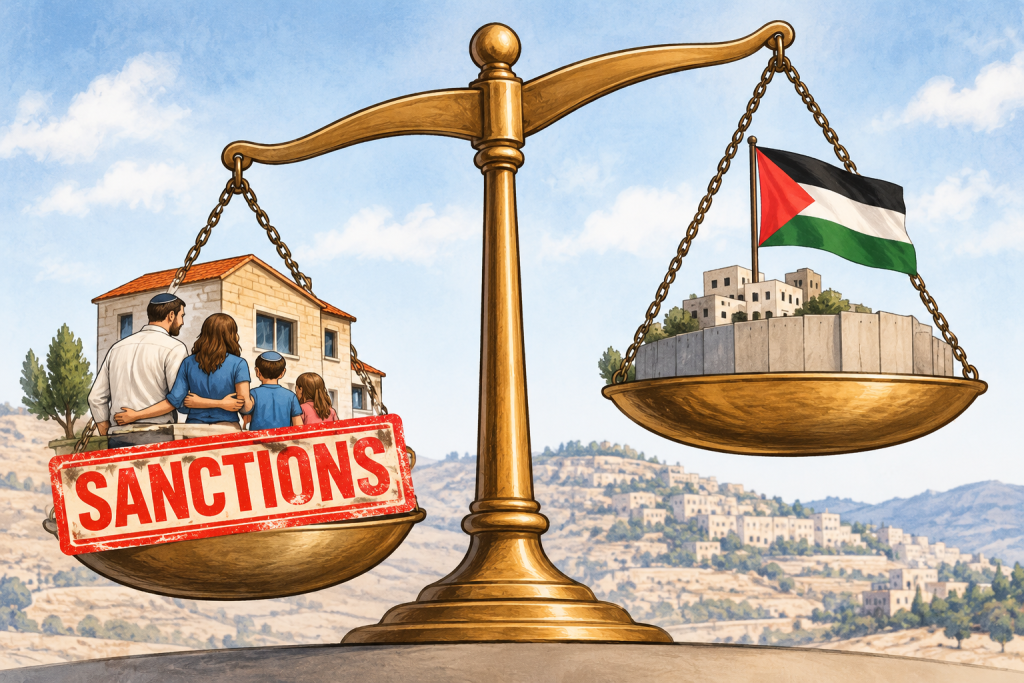
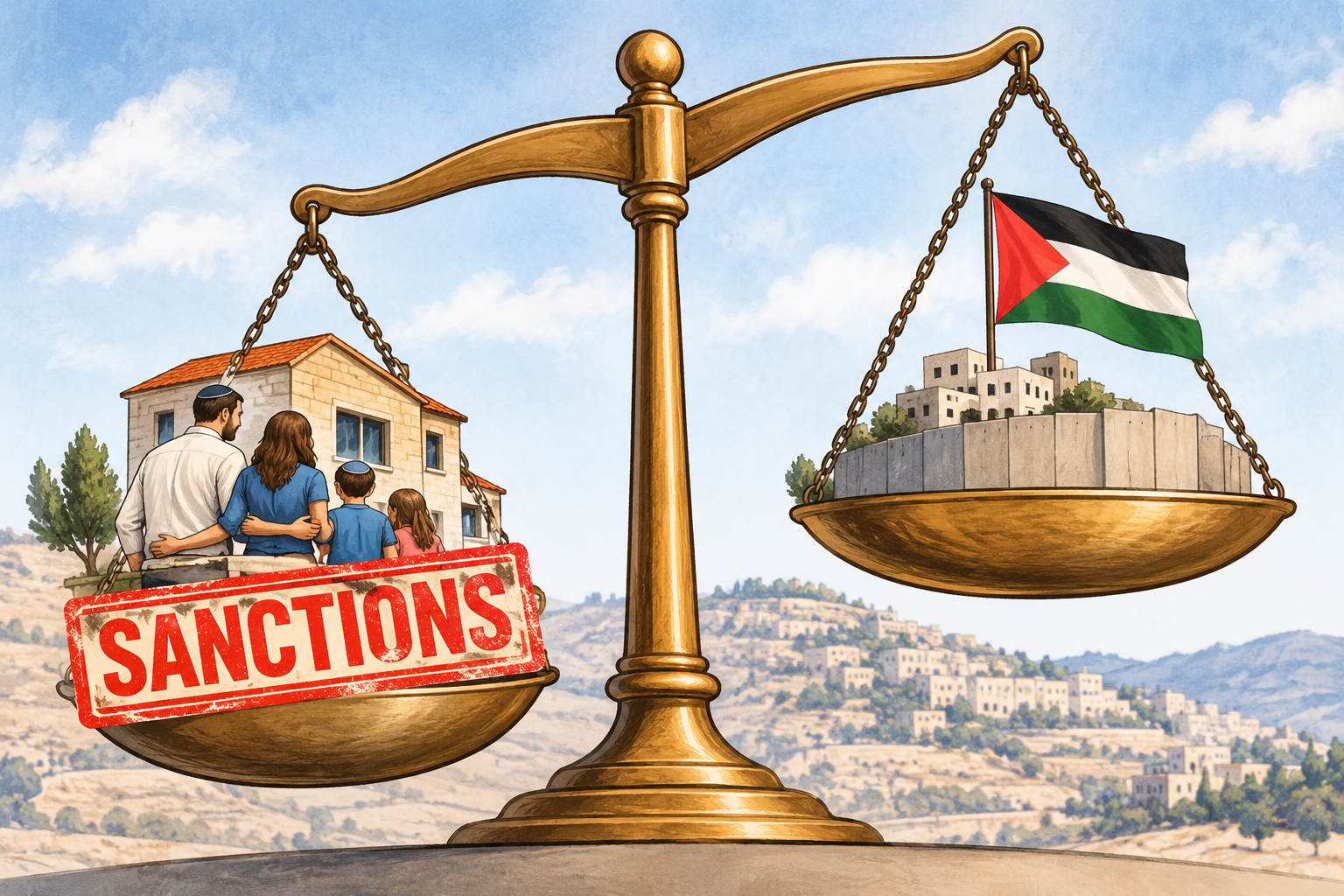
The United Kingdom and Australia have imposed sanctions on several Israeli companies for building homes in Jewish communities in the West Bank. A bill cosponsored by more than 70 House Democrats would do the same thing. It appears that in no other context has anyone been sanctioned for building homes before, but the governments explained their action as necessary to “protecting the two-state solution.”
The sanctioners assume a Jewish minority population makes a Palestinian state not “viable.” Why that should be the case isn’t clear. One-fifth of Israel’s population is Arab and, despite significant intercommunal tensions, Arab parties enjoyed unprecedented success in the recent Knesset elections. An Arab nationalist party and a party which traces its roots to the Muslim Brotherhood are now potential kingmakers in forming a government in the world’s only Jewish-majority state. In the unrealistic scenario that all the Jews in Judea and Samaria chose to become citizens of a Palestinian state, they would constitute perhaps 10% of the population.
This highlights a deep paradox in calls for a “two-state solution” to accommodate the two peoples in the area. While the civil rights of Arabs are considered a sine qua non for the Jewish state, advocates don’t make any such demands for Jewish rights in a Palestinian state. Only in Israel would “both peoples . . . live side by side in peaceful co-existence,” as U.K. Foreign Secretary Ed Miliband put it. Next door, in a Palestinian state, the sanctioners are tacitly endorsing an ethnically pure state.
Palestinian Authority President Mahmoud Abbas has declared that in a Palestinian state “we would not see the presence of a single Israeli . . . on our lands.” Palestinian law bans the ownership of land by Jews, and the PA arrested several Jericho residents this month for brokering private land sales to Jews. Why don’t Western liberal backers of a Palestinian state make the same demands of the Palestinian Authority as they do of Israel?
To be sure, Palestinians and Jews have a longstanding enmity. But that would never be accepted as an excuse for disenfranchising Israel’s Arabs. Palestinian leaders might worry that a Jewish minority would ally itself with Israel, but Israel has the same concerns about its Arab population, whose political parties openly embrace the Palestinian national cause; some even refuse to label Hamas a terror group.
It is one thing to have two states with distinct ethnic majorities, each with a minority population in the other. It is another thing entirely to have a monolithic ethnostate that also has ties to a minority population in its multiethnic neighbor. The former is common: Think of Denmark and Germany, or Italy and Slovenia. The latter is a recipe for the destabilization of the pluralistic state.
But advocates of a Palestinian state don’t demand the protection of minority rights as a precondition for such a state, as they do for Israel. Some might insist the Palestinian objection isn’t to Jews per se, but to Israelis. But when Israeli Arabs buy or build homes in the West Bank, the PA and its allies don’t denounce them as settlers and demand their removal.
Indeed, many Israeli Arabs maintain a strong Palestinian identity, support the Palestinian national movement and fly the Palestinian flag. Israeli Arab Member of the Knesset Ahmad Tibi served as an adviser and negotiator to PLO Chairman Yasser Arafat. Mr. Tibi just became deputy speaker of the Israeli Knesset.
Some might wonder whether Palestinians can live peaceably alongside Jewish Israelis, who they would see as “relics of occupation.” But Israelis could have argued in 1948 that the new Jewish state shouldn’t “inherit” an Arab population that may have sympathized with or assisted the Arab invasion of Israel with the declared intent of destroying it, or that participated in the wave of terror that killed hundreds of Jews from 1936 to 1939.
Since then, some Israeli Arabs have committed terror attacks in the Palestinian cause, with a significant increase since the Gaza war. Israel is still scarred by the Arab riots of 2021, which saw widespread stabbings, arson, attempted home invasions and shootings. By contrast, despite several major Arab-Israeli wars, the Arab population in Israel has lived entirely unmolested by the kind of riots and pogroms that drove 800,000 Jews out of the rest of the Middle East.
Jerusalem could reasonably be concerned that a Palestinian state would foment civil war in its ethnically mixed neighbor. Yet Western two-staters would decry it as racism if Israel demanded that a peace treaty with a Palestinian state involve the transfer of its Arab population.
Those who embrace coexistence of Arabs and Jews in Israel should demand nothing less from the Palestinians. By failing to do so, they are endorsing a belligerent Palestinian state and conceding that they envision a future that looks less like postwar Italy and Slovenia than like Russia and Ukraine. Admittedly, political equality for Jews in a Palestinian state seems unlikely given that the Palestinian Authority hasn’t allowed its own citizens to vote in national elections in two decades. Sanctions on building homes for Jews are simply an endorsement of Palestinian leaders’ vision of an apartheid-like state without Jews, and a tacit concession that the peace processors don’t truly expect the Palestinian state to be either peaceful or democratic, but insist on forcing its creation anyway.
(First published in The Wall Street Journal, “Sanctioning People for Building Homes in the West Bank”, 23.11.2026)