While the legal proceedings in the ICJ over “genocide” continue to cast their shadow over us, the state of Israel has one last chance to elude the Court’s jurisdiction and resoundingly reject the legitimacy of the proceedings.
Towards the end of October, when Israel goes to the ballot box, the ICJ is expected to issue its decision on Myanmar. In this less politically volatile case, the court is predicted to redefine the crime of genocide in a way that will later serve it to find Israel guilty. To this day, Israel continues to grant the ICJ jurisdiction, because of failed and defective legal counsel.
In 2019, The Gambia filed a complaint against Myanmar for the alleged genocide of the Muslim minority of the Rohingya. One of the fundamental questions to be decided is the standard of proof required to establish intent to commit genocide. The Convention on the Prevention and Punishment of the Crime of Genocide defines genocide as any of five acts “committed with intent to destroy, in whole or in part, a national, ethnical, racial or religious group, as such.” Case-law has refined and tightened the requirement of “special intent” (dolus specialis) to commit genocide.
Courts may infer intent to commit genocide from official documents or public statements. In the absence of this type of evidence, courts may infer genocidal intent from systematic patterns and conduct. But, and this is the crucial point, the conclusion must be the only reasonable inference that can be drawn from the conduct. The International Criminal Tribunal for the former Yugoslavia (ICTY) has already rejected genocide claims in cases where the Serbian army acted out of military necessity, even if it violated the laws of war and killed civilians. The Gambia is asking to replace the “only reasonable inference” test with a “reasonable inference” one.
As regards Myanmar, there is no need to lower the evidentiary threshold – Myanmar’s army conducted mass executions of the Rohingya, who posed no military threat. However, certain states like Ireland and Belgium, as well as leading legal scholars, are pushing for the adoption of the “reasonable inference” test, to pave the way for Israel’s conviction. Obviously, the ICJ will find no “smoking gun” in the form of Israeli orders to wipe out Palestinians as such. The fighting in Gaza is one of the most complex urban theaters in the world, with Hamas deliberately hiding among the civilian population. A ruling against Israel would open the way to arrest warrants against senior Israeli officials around the world, an arms embargo, and boycotts: a legal-diplomatic October 7 by all accounts.
As for the ICJ proceedings, Israel has acted with negligence, apparently due to naivety. Many states that joined the Genocide Convention, including the US, refused to accept the court’s jurisdiction to hear cases against them in the event of a dispute.
The Israeli government’s legal advisers, however, never warned them that the Convention could be abused and turned against us, and did not advise a withdrawal. When South Africa filed its complaint, Israel sent former Supreme Court President Aharon Barak to the proceedings, in an attempt to persuade and impress the court, but this only lent it even more legitimacy. When the US faced abusive proceedings before the ICJ, it withdrew from the relevant conventions. This has also been our recommendation since 2024.
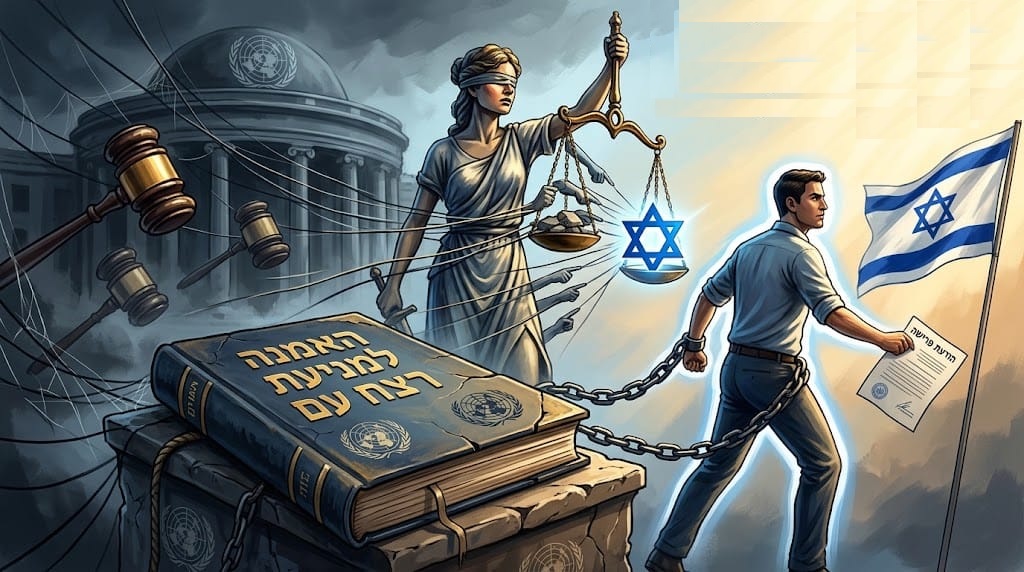
Israel must immediately withdraw from the Genocide Convention. Under its provisions, withdrawals can be effected once every five years. The last “window” passed in January 2026, yet the Foreign Ministry’s legal team “missed” the date. The Genocide Convention was one of the first Israel joined in 1949, but it never anticipated such a despicable use of the convention against itself. Using every means at its disposal, Israel should protest the cynical use that has been made of the Convention, and withdraw from it, while declaring that it remains committed to the Convention’s substance, as what accords with its values as a Jewish state.
If this disgrace is allowed to pass without protest, states fighting difficult wars may find themselves accused of genocide, while the unique nature of the concept and the crime is eroded. Withdrawal might spur the United States to act against the court, and could even avert the worst in the Myanmar case.
We are liable to find that after the elections, the next government no longer has room to act.