By: Yeshaya Rosenman
Professor Jack Wertheimer, veteran researcher of Jewish philanthropy, published two lengthy essays in the Jewish-American Mosaic magazine, in which he took account of the Jewish-American community since October 7. He anonymously interviewed a long list of Jewish leaders in the US, and in his instructive review, detailed, among others, what Jewish organizations did with the sudden inundation of donations; who reaffirmed their Jewish identity and how; what new initiatives succeeded; and what settled initiatives achieved when the time came to prove themselves.[1] I would like to expand on his work regarding an issue these essays touched on only implicitly: on what should alliances forged between the nation of Israel and its friends be based?
Prof. Wertheimer discussed the alliances forged by American Jews, but some of his insights are relevant to the State of Israel’s alliances as well. In any case, I think Israelis should have an opinion on the Diaspora as they do on internal affairs, for several reasons:
First, it has proven to be the case that Diaspora affairs, and no less on its Jewish identity, are most impacted by events in Israel. If Israel is the trigger – for good and ill – it is wise to put our heads together and strategize. The other option for Diaspora Jews – the attempt to deliberately differentiate themselves from Israel – means giving up on their strong Jewish identity, aside from the fact that this evidently does nothing to persuade anti-Semites.
Secondly, Israel has capabilities the Diaspora lacks – not only the state’s official agencies, the foreign and defense ministries and the intelligence services, but also experts the likes of whom are few and far between outside the country: Israeli Middle East experts speak about the dangers of political Islam in a way most of their overseas colleagues don’t dare; young entrepreneurs can marshal technological ability to serve public good initiatives; and an array of Israeli intelligentsia members are developing Jewish-Israeli scholarship that should spread its light across the sea as well as among other nations.
Finally, for whatever the reason, many in the Diaspora Jewish leadership have inherited the fatal political blindness of pre-WWII German Jewry, a blindness they couldn’t shake till the bitter end. Israel is largely peopled with those who don’t presuppose political fantasies, and are far more politically pragmatic than Diaspora Jews – even the rich and powerful.
Identity-Incompatible Alliances Are Doomed to Fail
Many of the leaders Wertheimer interviewed honestly acknowledged their failures. They admitted that they had lived under illusions, and had cultivated alliances “built on sand”, with supposed partners who badly betrayed them in the test of October 7. This despite the financial resources invested – including funded delegations to Israel – and the efforts put into building those relationships.
Why did some alliances fail while others withstood the test? I would like to highlight identity as the critical factor. There are two dimensions to the neglect of this element: first, a lack of understanding or interest in foreign cultures; and second, a failure to distinguish between interest-based alliances and identity-based alliances. These two dimensions give rise to two categories of failure.
To the first category I would assign the disappointment with the alliances formed with the Arab and Pakistani communities in the United States. In both of these cultures, intense antisemitism is a default position, so taken for granted that there is little awareness that it is a view that should not be expressed outside the community. The upper-middle class of the Pakistani diaspora is far more sophisticated than Arabs in concealing these views, and it is safe to assume these were the interlocutors of the Jewish community – yet to fail to notice antisemitism so intense and so pervasive requires a fundamental misunderstanding of the culture, or even a principled disinterest in cultures altogether, nurtured by the illusion that “here we are all Americans.” Although it is true that experts on Pakistan are few among the Jewish people, and information was not necessarily available, the question should have been raised at least regarding Arabs communities.
In these cases, it became clear that culture, like religion, is not easily changed- not even in the wake of a lavish complimentary trip to Israel. The deep antisemitic instinct remained as the bedrock, and the earthquake of October 7 tore away the flimsy tent that Jews had erected on its foundations.
The disappointment with the ideological left belongs to the second category. Here the prevailing assumption was that coalitions could be built around shared left-wing political interests, without any need to pay special attention to partners’ identity. But in the moment of reckoning it became clear that views on abortion, guns, or religious freedom were not the bedrock – the clash between the Jewish and the antisemitic ran deeper. To this one must add that some of the ideas championed by the left — such as post-colonialism, the fight against “Islamophobia,” or various strands of Marxism — had been trending all along toward hatred of Israel, and it took a considerable dose of repression on the Jewish side not to notice that the hostility could erupt against a left-wing Jew and not only against the “bad Jews” of the right.
An interest-based alliance should resemble a one-time transaction – buyer and seller, product and price. But long-term business partnerships also require personal compatibility. Similarly, even interest-based alliances require transparency about the question: whose interests? Wertheimer interviewed Jewish leaders who consciously prioritize the interests of the broader left-wing camp over the interests of the Jewish people, arguing that leftists are natural allies, and this trade-off would be worthwhile in the long run. This runs in Israel somewhat parallel to the tendency of “anywhere” Israelis – in terms of the “Somewheres and Anywheres” thesis – to make similar choices.[2]
Old American Friends and New Indian Ones
At the other end of the spectrum are philo-Semitic cultures and sub-cultures that express ideological and/or religious solidarity with Israel. Their support of Israel is rooted in the foundation of their identity as well as in metaphysics. I need not expand overmuch on the Evangelicals in the Bible Belt or the Black Baptist churches in the US, and their steadfast support for Israel throughout the war. This despite the fact that even some of the senior leadership in Israel, not to mention the Diaspora, are apparently still unconvinced, and their resistance is also linked to questions of identity.
But we have supporters beyond the US. To whomsoever who has not yet noticed, let me serve as the bearer of good tidings: we have another community of friends out there. It is an enormous, global, talented community, rich in resources and networks, one that holds influential positions in industry, finance, science, technology and politics in nations that are key to Israeli interests, and even leads a rising superpower: The Hindu right in India and the Indian Diaspora.
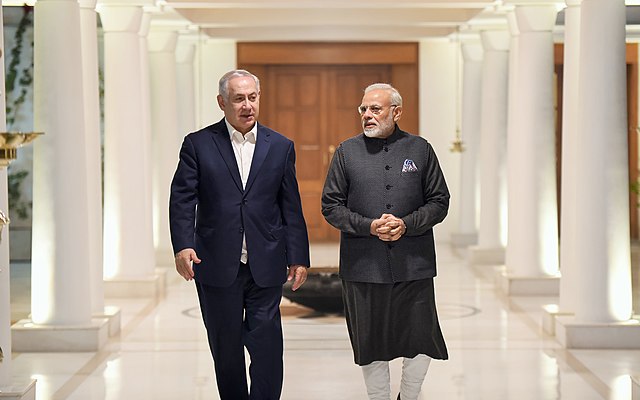
Prime Minister Narendra Modi was the first world leader to support Israel on October 7, and the Indian media has been so enthusiastic in its support of Israel (up till the strike on Iran, which entangled with internal Indian politics vis a vis the US), that they suffered the usual accusations of “Zionism” from Arab and Pakistani media. Hindus are numerically the largest pro-Israel force on social media, even though most of the Indian feed doesn’t reach the West.
And yet, aside from some vague generality regarding a supposed hostility to Muslims, the average Jew knows nothing of the Hindu world, even when he cheerfully converses with Hindus at pro-Israel rallies in California.
The upper-middle class strata of the Hindu right are well-educated, and possess their own culture, history and sociology, which all require study. Theirs is not a Biblical-Abrahamic culture, and they are engaged in a two-century-long battle against the Evangelicals over their continuous efforts to proselytize, something that was recently echoed in Catholic Vice President JD Vance’s expressed hope that his wife Usha convert. However, aside from the Evangelical context, there is a near perfect match between Indian/Hindu interests and Israeli ones: they have the same general friends and enemies, sometimes found in the very same people and organizations. Zohran Mamdani and his confederates are one prime example. Researcher Salvatore Babones is right to point out that Western hostility towards India is a copy-paste of the narratives against Zionism, Israel and settlers, and there is a significant correlation between antisemitism and antizionism and hatred towards India and Hindus.[3]
Israel has longer experience with these narratives, but we never had the size required to defeat our many enemies in the battle for international legitimacy. My hope is that the Israeli government, and even more so non-governmental organizations, direct resources to synergize Israeli software with Indian hardware, and produce a new machine that can fight back powerfully against our shared enemies.
There is a reason that on his latest visit to India, Foreign Minister Gideon Sa’ar spoke of “long-term strategic partnership”,[4] despite India belonging to no geopolitical faction, not even the Western-American one. This alliance is not grounded simply on shared economic and strong geopolitical interests (that are subject to change), nor only on a shared enemy in the red-green alliance, but on the roots of the Hindu right’s identity, one that sees Zionism as the form of nationalism closest to the Hindu’s – two grand and ancient civilizations being reborn in their holy ancestral land, after long humiliation at the hands of Muslim and Christian conquerors. The Hindu right opposed the partition of Israel as much as they opposed the partition of India, and will no doubt support building the Temple in Jerusalem as much as they supported building their own temple in Ayodhya.[5] It is unfortunate that the alliance between Hindus and Israeli setters has not yet been forged, and the official Indian position is a boycott of the settlements.
The Indian left is hostile to Israel, and its theoretical work is the basis for Zohran Mamdani’s world. We must learn to discern between the left and the right, especially among the Hindu Diaspora. As a rule of thumb, one can find a correlation between Hindus’ active efforts to promote a love for India and its government, cultivate a Hindu identity, and prevent complete assimilation, with their support for Israel. The clearest cases are the professional activists in Hindu organizations such as the Hindu American Foundation and CoHNA (Coalition of Hindus of North America). Their activity openly models itself on Jewish activism, and they regularly seek opportunities to cooperate with Jewish people; however, they don’t always find a willing ear or understanding from the Jewish side.
It must be regrettably acknowledged that most American Hindus are focused on making money, pursuing careers and assimilating/integrating into the US, and their community has not yet developed community institutions like the Jewish ones. They do not invest much effort in preserving their identity beyond attending temple worship, and they are particularly wary of openly supporting causes that can bring them into conflict with American elites. One great example of this is the fact that only one American Hindu student organization, Hindu on Campus, protects the community’s interest. When I tried to discover who was behind the organization’s X (formerly Twitter) account, I found it to be a virtual organization whose members stayed anonymous. However, Indians represent 70% of those entitled to H-1B visas, and the Hindu community is fast growing. Size and power may well increase their courage, and it must be hoped that Israelis and Jews can both confer and learn that courage.
Another Eastern Friend: Taiwan
Another surprising friend of Israel has emerged in the East: Taiwan. This talented and productive state, with which Israel and other Western countries have no diplomatic ties due to the “One China” policy, has emerged in this war as an active supporter of Israel, to no less a degree than our traditional supporters among the evangelical Korean community or the Japanese Makuya.
Taiwan’s representative in Israel, Abby Ya-Ping Lee, announced millions of shekels’ worth of donations towards rebuilding war damage in Bat-Yam, as well as the establishment of a medical center in the Binyamin region. Official Israel has only limited options regarding Taiwan, but why should Israeli civil society not embrace the potential of an alliance without fear of the Chinese government?
An alliance with Taiwan would be based on values, such as the belief in freedom and opposition to Chinese tyranny, but even were it to be based on interests alone, these interests are not likely to change in the foreseeable future. To the contrary, Israelis becoming allies to the threatened Taiwanese could be remembered for generations, even after the Chinese threat is removed. However, here too, it is important to deepen our understanding of local culture and try as far as possible to draw parallels of similarity and identification.
New Converts: the European Right and Gulf Monarchies
Similar to the rise of the Hindu right, the rise of the European right in recent years has also been accompanied by a surprising turn in favor of Israel. Parties and populations that were previously associated with fascism and even Nazism now vigorously support Israel, even in countries such as Sweden and the Netherlands, where support for Israel was until recently considered a morally reprehensible position.
Not all European right-wing parties are created equal: some support a welfare state, others favor small government; some are entirely sympathetic toward Israel, while in others, the line between love and hatred of Israel runs through the party and its voters alike. But in all of them, the alliance is grounded in values or religion. It is not merely a matter of shared hostility toward Muslims, but rather a values-based identification with Israel around shared principles: the values of the West and the free world, or the values of the Bible and the Christian world.
The traditional monarchies of the Emirates and Saudi Arabia arrive at their supportive stance toward Israel from a different direction: threatened by revolutionary political Islam, they seek to shape a tolerant and peace-seeking Islam, embodied in the Emirati “Ministry of Tolerance and Coexistence” and in public projects in Abu Dhabi such as the “Abrahamic Family House” inaugurated in 2023, and the permission to construct the massive Hindu temple of the Gujarati BAPS movement, inaugurated in 2024.
The ruler of Abu Dhabi and President of the United Arab Emirates, Mohamed bin Zayed Al Nahyan, and Saudi Crown Prince Mohammed bin Salman are leading a quiet reform of local Islam, backed by select religious figures and with the strong hand possible in non-democratic states. This is an elite-driven initiative, imposed from above on subjects who are required to demonstrate loyalty rather than agreement. The reform of Saudi Islam harbors ambitions for such fundamental change that the figure of Muhammad ibn Abd al-Wahhab, father of the kingdom’s Wahhabi Islam, has been erased from textbooks. The void is being filled by Saudi patriotism, centered on bin Salman and his achievements in bringing prosperity to the kingdom.
The interest of these kingdoms in an alliance with Israel is clear, even if public opinion in their countries compels them to exercise caution and issue carefully worded statements. They seek an alliance with a regional power for the eradication of political Islam wherever it exists, and for broad technological cooperation toward development, job creation, security, and national and regional prosperity.
Such interests are important as well as self-evident; however, we should seek to deepen this new alliance and enhance it with a religious-ideological dimension. This will not be easy given the kind of statements made by Finance Minister Smotrich, for instance,[6] or conservative Rabbis, but it is actually the religious right and the settlers who are the natural friends of Gulf Arabs, and who have the potential to serve as the inspiration they seek: bearded men and head-covered women who are religiously educated, have large families and live full religious lives, but are integrated into the modern world and the international tech scene.
It cannot be denied that this would require a change of approach by religious leadership as well as in religious education, to better open the hearts of religious youth towards beneficial and fruitful relationships with non-Jews who are not enemies of Israel in the way the Palestinians are.
Yet herein lies the potential for the long-awaited shift in Muslim public opinion toward Israel, someday. The process will take a generation, or several generations, and requires staying power, but the reward is worth it. Saudi Arabia is the leader of the Sunni world, and the patron of countless Muslim countries, Islamic institutions, and academic chairs in the West. If the reforms in Saudi Arabia are crowned with success – including a change in attitude towards Jews in textbooks and in the media – then globalizing de-radicalization through Saudi and Emirati agents should be encouraged.
It is not clear to me why the reversal of the hostile attitude toward Israel and Jews in Western academic forums funded by Saudi money, and of prominent anti-Israel Saudi figures such as Al-Waleed bin Talal of the House of Saud, has not yet entered the discourse around normalization.
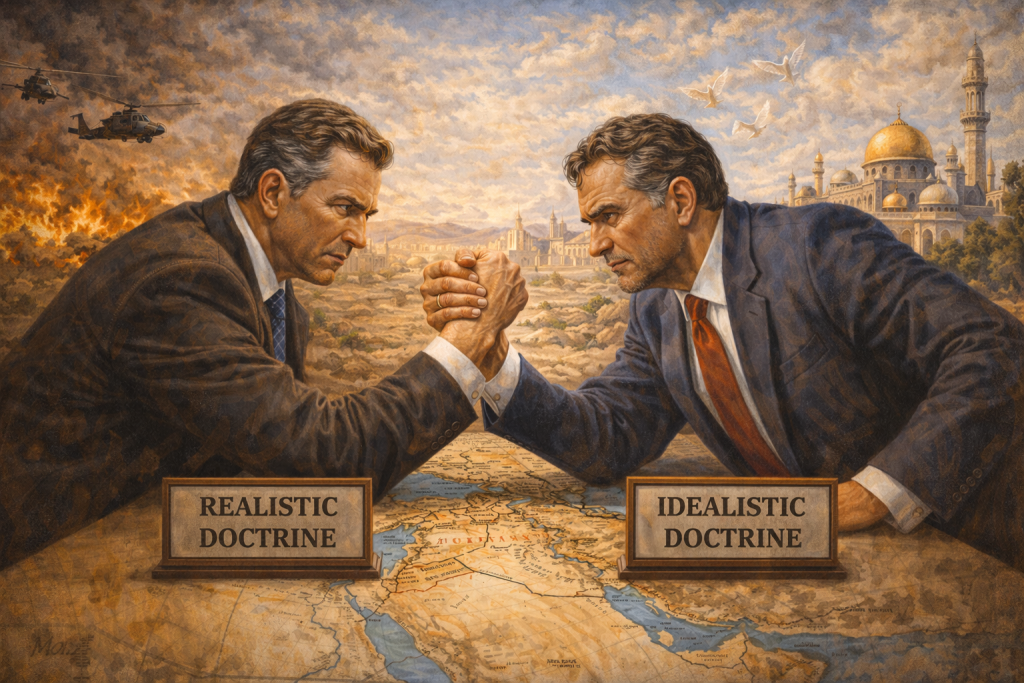
My hope is that Israeli leadership, rooted in our tradition and heritage, will know how to lift its gaze above the provincial walls of its neighborhood and correctly identify our friends around the world. We must think, plan, and anticipate the future, and conduct ourselves as befits a regional power, capable of projecting both hard and soft power. Precisely because we have always insisted on not believing in absurd dreams of a new Middle East without enemies, we will be able to forge realistic alliances with true friends throughout the entire world.
Yeshaya Rosenman is a scholar of modern India, the subcontinent countries and their diasporas.
Photo Credit: PMO India
[1] Jack Wertheimer, “What American Jews Gave After October 7: An Accounting”, Mosaic (Nov. 4, 2024), https://did.li/m1pDN ; Jack Wertheimer, “American Jewry’s Anti-Semitism Reckoning”, Mosaic (Oct. 13, 2025), https://did.li/AUGOf .
[2] For expansion on David Goodheart’s “Somewheres and Anywheres” formulation in the Israeli context, see Gadi Taub, Global Elites and National Citizens: The Attack of the Upper Classes on Israel’s Democracy [Hebrew] (2021).
[3] Salvatore Babones, Inside the Campaign to Malign India in the West, Sanatan Prabhat (Apr. 25, 2024), https://sanatanprabhat.org/english/99660.html .
[4] https://www.gov.il/en/pages/fm-sa-ar-meets-with-indian-external-affairs-minister-dr-jaishankar-in-new-delhi-4-nov-2025
[5] See a summary of the issue on Wikipedia – https://en.wikipedia.org/wiki/Ayodhya_dispute
[6] https://www.timesofisrael.com/smotrich-on-saudi-normalization-no-thank-you-keep-riding-camels/