The United States and Israel have been in an international armed conflict with Iran for decades
An international armed conflict (IAC) has existed between Iran, the United States, and Israel for over four decades, originating with Ayatollah Khomeini’s 1979 proclamation of “death to America and Israel”. This state of war has persisted through a decades-long proxy campaign and culminated in Iran’s first direct assault on Israel in April 2024. Throughout this period, Tehran has waged war via various terror surrogates, including Hezbollah, Hamas, the Houthis, the Taliban, and Afghan Shia militias. Because this conflict is already established, the legal framework for evaluating recent American and Israeli military operations shifts from jus ad bellum—the justification for resorting to force—to jus in bello, which governs the actual conduct of warfare. This transition in legal analysis is firmly supported by both contemporary scholarship and established state practice.
The Existence of an Armed Conflict between the United States and Iran
The relationship between the United States and the Islamic Republic of Iran is not merely one of diplomatic tension but a persistent, low-intensity International Armed Conflict that has existed since 1979. This conflict was inaugurated by a direct violation of sovereign immunity during the US Embassy hostage crisis—an act of state-sanctioned aggression that served as a casus belli. Since that inflection point, Iran has shifted from traditional diplomatic engagement to a strategy of “proxy mobilization,” using groups such as Hezbollah and various Iraqi militias as functional organs of the Iranian state. Under the legal doctrine of State Responsibility, the provision of sophisticated weaponry—such as the Explosively Formed Penetrators (EFPs) responsible for the deaths of over 600 American service members in Iraq—constitutes a direct use of force by Tehran against the United States, regardless of the “gray zone” tactics used to mask its involvement.
Furthermore, the conflict has frequently escalated into direct, kinetic state-on-state violence, stripping away the veneer of plausible deniability. From the naval surface battles of Operation Praying Mantis in 1988 to the 2020 ballistic missile exchanges following the strike on Qasem Soleimani, the two nations’ regular armed forces have engaged in lethal combat that meets the technical definition of an armed conflict under the Geneva Conventions. This “hot” theater of war is now expanding into the global arena. By transforming itself into the “arsenal of autocracy”—supplying loitering munitions to Russia for use against Western-aligned interests and conducting maritime sabotage in the Red Sea via Houthi surrogates—Iran has entered a state of co-belligerency against the US-led security order.
Ultimately, the recent discovery of Iranian-backed assassination plots targeting a US President and high-ranking National Security officials marks a final transition from regional friction to an existential attack on the United States. When combined with Tehran’s systematic violations of international maritime law and its economic alliance with America’s primary global rivals, these actions reveal a consistent animus belligerendi (intent to wage war).
The Existence of an Armed Conflict between Israel and Iran
The existence of an armed conflict between Israel and Iran is undeniable. As the ICTY Appeals Chamber in Tadic stated, “an armed conflict exists whenever there is resort to armed force between States” (para. 70). According to the ICRC Commentary on Common Article 2 of the Geneva Conventions, the question “how much slaughter takes place” is not relevant to whether an IAC exists; and, even if there is “only a single wounded person as a result of the conflict”, the law of armed conflict applies (ICRC Commentary of 1952, Dinstein, Non-International Armed Conflicts in International Law, p.51).
On 13 April 2024, Iran launched its first direct attack on Israel, sending around 170 drones, 30 cruise missiles, and 120 ballistic missiles towards Israel. The strike has been called the most significant attempted drone attack in history and, in a continuation of the IAC, followed an alleged airstrike by Israel on officers of the Islamic Revolutionary Guard Corps (IRGC) near the Iranian embassy complex in Damascus, Syria. One Israeli civilian was critically injured, and 31 other civilians were treated for minor injuries or post-traumatic stress. On 1 October 2024, Iran launched 200 ballistic missiles at Israel in two waves. The attack killed one Israeli civilian and one Palestinian civilian, as well as causing major damage to Israeli homes. Between June 13 and 24, 2025, Israel fought a 12-day high-intensity conflict with Iran, with American support.
An armed conflict does not necessarily end even if there is a temporary lull in hostilities. Dinstein, for example, justifies Israel’s 1981 strike on the Iraqi nuclear reactor and the 2007 attack on the Syrian nuclear reactor based on the state of hostilities that existed between the parties as of the 1948 war. Israeli, Iraqi, and Syrian armed forces fought against each other in June 1967 and October 1973. Iraq launched Scud missiles at Israeli population sites in 1991. “The Iraqi missile offensive against Israel must be observed in the legal context not of the Gulf War but of the war between Iraq and Israel, which started in 1948 yet continues to this very day. That war is still in progress, unhindered by its inordinate prolongation since 1948, for hostilities flare up intermittently” (War, Aggression and Self-Defence, p. 45). The ongoing IAC between Iran and Israel has lasted a similar period, over four decades.
The ICRC Commentary considers an armed conflict closed when “the likelihood of the resumption of hostilities can be reasonably discarded” (par. 278). Iranian leadership has consistently signaled the opposite, framing their military actions not as isolated incidents, but as a continuous campaign of resistance. In June 2025, following a wave of kinetic strikes, Supreme Leader Ali Khamenei reinforced this state of perpetual hostility by declaring that the “Zionist regime has committed a crime in our dear country… with its satanic, bloodstained hands.” This sentiment was further solidified on February 21, 2026, when President Masoud Pezeshkian emphasized that despite global pressure, Iran would “not bow its head” to the world powers attempting to force its capitulation.
The most definitive evidence that the likelihood of resuming hostilities has not been “discarded” came on February 28, 2026. Upon launching “Truthful Promise 4”—a series of retaliatory strikes directly targeting U.S. bases in Qatar, Bahrain, and the UAE—the Islamic Revolutionary Guard Corps (IRGC) issued a formal declaration of sustained warfare. The IRGC stated that “this operation will continue relentlessly until the enemy is decisively defeated,” while explicitly designating “all US assets throughout the region” as “legitimate targets.” By committing to a relentless campaign aimed at the decisive defeat of the United States, Iranian leadership has effectively codified the existence of a continuous and open International Armed Conflict.
Attribution of Hamas, Hezbullah and Houthis Attacks to Iran
There is a strong argument for attributing Hamas, Hezbollah, and Houthis’ attacks on Israel to Iran, including those over the period post-dating 7 October 2023. UNGC 3314 recognizes “substantial [State] involvement” in armed group attacks as an “act of aggression” (Article 3(g)). Iran’s training and provision of weapons to armed groups certainly meet the standard of “substantial involvement”.
Attributing proxy attacks to Iran strengthens the case that an IAC has long been in existence. While such attacks reach back decades, the conflict has unquestionably been ongoing since Iran’s resort to force on 7 October 2023, when Hamas attacked Israel. Hezbollah began firing on Israeli cities the next day. UNGC 3314 recognizes “substantial [State] involvement” in armed group attacks as an “act of aggression” (Article 3(g)). Iran’s training and provision of weapons to armed groups certainly meets the standard of “substantial involvement”. Scholars such as Tom Ruys and Carsten Stan have argued that “substantial involvement” must be understood consistently with “overall control” criteria (see Flasch).
ICTY Tadić’s “overall control” test criteria are: equipping, financing, and coordinating military activity suffice, without specific act instructions (para. 131). Other factors include organization, training, equipping, operation planning, target selection, and support (para. 112).
According to reports in the Wall Street Journal, in the weeks preceding the October 7th attacks, approximately five hundred Hamas and PIJ militants received specialized combat training in Iran. These exercises were conducted by the Quds Force, an IRGC division tasked with training paramilitary groups, and were attended by senior Palestinian officials and Brigadier General Esmail Qaani, the head of the Quds Force. The methods and technology employed by Hamas, such as aerial drones and motorcycle attacks, bear distinct Iranian characteristics. Another report indicates that the attack was meticulously coordinated for months between the IRGC, Hamas, and Hezbollah, with Iranian officials giving the final approval in a meeting in Beirut the Monday before the attack. After the attack, Hamas spokesman Ghazi Hamad informed the BBC that Hamas had Iran’s direct support and that it would “stand by the Palestinian fighters until the liberation of Palestine and Jerusalem.” Following the attack, Ayatollah Khamenei expressed his support, stating that Hamas had dealt “a decisive blow to the Zionist regime” and set Israel “on a path that will only end in its destruction.” Since October 7th, Iranian officials on several occasions have openly admitted Iran’s involvement in the attacks. For example, the Iranian news agency Tasnim, affiliated with the Revolutionary Guard, published a report on October 15, 2023, detailing Hamas members receiving Iranian training for four years before the assault and outlining the key role played by the Iranian regime and military in its preparation.
Iran’s relationship with Hezbollah is characterized by deep strategic and operational support, positioning Hezbollah as a key proxy in Iran’s regional strategy against Israel. According to the Center for Strategic and International Studies (CSIS), Iran, through its IRGC, has been the primary supplier of Hezbollah’s arsenal, providing an estimated 120,000–200,000 rockets and missiles, along with funding and training since Hezbollah’s founding in 1982. This support enables Hezbollah to conduct sophisticated attacks, including using precision-guided munitions, while aligning its operations with Iran’s broader “Axis of Resistance” objectives. Iran’s logistical network, including a “land bridge” through Syria, facilitates continuous resupply, reinforcing Hezbollah’s role as an extension of Iran’s influence in Lebanon and the region. Iran sees Hamas, Hezbollah, the Houthis and other militias as members of the “Axis of Resistance”, sharing a coordinated strategy to destroy Israel. Israel similarly sees itself in a seven-front war, with Iran as “the head of the snake”.
Jus Ad Bellum in Recent Strikes
Having established that Israel and Iran have been engaged in an ongoing armed conflict, the legality of Israeli and American operations must be assessed under jus in bello, not jus ad bellum. As part of an ongoing armed conflict, Israeli and American strikes in Iran cannot be considered retaliatory action (Cox). According to the United States’ official position as articulated by former State Department Legal Adviser Brian J. Egan:
“In the view of the United States, once a State has lawfully resorted to force in self-defense against a particular armed group following an actual or imminent armed attack by that group, it is not necessary as a matter of international law to reassess whether an armed attack is imminent prior to every subsequent action taken against that group, provided that hostilities have not ended”.
Dinstein, similarly states that jus ad bellum proportionality is irrelevant throughout the hostilities in the course of war. “Once the war is raging, the exercise of self-defence may bring about ‘the destruction of the enemy’s army’, regardless of the jus ad bellum condition of proportionality” (War, Aggression and Self-Defence, p.208).
Conclusion
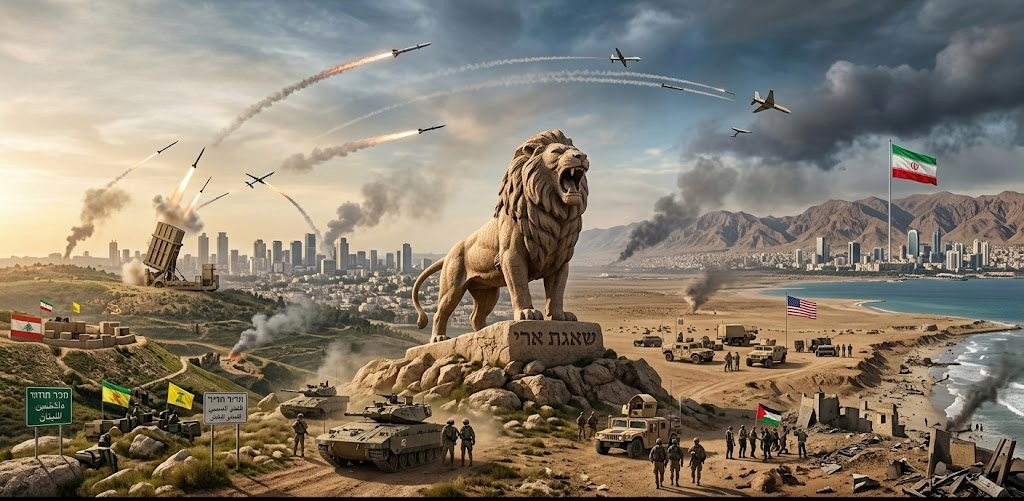
Because Operation Roaring Lion occurred within an established and unceasing armed conflict, its legality is not determined by whether it was a “proportionate” response to a single event. Instead, the operation is governed by jus in bello standards, meaning it is legally permissible so long as it adheres to the principles of distinction, military necessity, and the avoidance of unnecessary suffering during the conduct of hostilities.