By: Elitzur Segal
The chaos on our northern border forces us to look beyond the border fence at what is happening in the north.
The region of western Asia where Syria, Lebanon, Jordan, and Israel are located today was known by the Europeans as “the Levant”, and in Arabic as “al-Sham”. The city of Damascus is also called “al-Sham” in Arabic, just as in Hebrew the words “Zion” and “Jerusalem” serve as both the name of the city and as a designation for the Land of Israel as a whole. Maimonides translates the term “al-Sham” as “the Land of Israel”. “Shami” means of the Land of Israel, and conversely, “the Land of Israel” is called “al-Sham”.
In 1517, the Turks conquered the region, defeating the Iranians to the east and the Egyptians to the south. The area was composed of an ethnic mosaic of many groups; a religious mosaic of different faiths; and a national mosaic of many peoples. The Turkish approach to managing this diversity was to create autonomous regions and balance power among the different groups. They divided the region into four “Vilayets” (provinces): (i) the Vilayet of Beirut, which stretched along the Mediterranean coast and included the Alawite region of present-day Syria, present-day Lebanon, and the western side of the Jordan where present-day Israel lies up to the border with Egypt; (ii) the Vilayet of Damascus, which included the eastern side of the Lebanese mountains and eastern Transjordan, extending to the Arabian Peninsula; (iii) the Vilayet of Aleppo, which included the north part of present-day Syria and part of southern Turkey; and (iv) the Vilayet of Mosul, which included part of northern present-day Iraq and part of eastern Syria. This division corresponded more or less to the geographical and ethnic realities of the region.
In 1831, Ibrahim Pasha, ruler of Egypt, conquered the Levant from the Ottoman Sultan. However, nine years later, in 1840, he was forced to retreat back to Egypt and return the region to the Ottomans by the European powers, including France and Britain. In his book “Modern Syria”, Prof. Moshe Ma’oz quotes Ibrahim Pasha’s words to a British officer: “It took me nine years and ninety thousand soldiers to bring order to this region. You will yet beg me to return”.[1] In his book, Ma’oz also cites a letter the French consul in Damascus wrote in 1840: “Everyone hates the Armenians, and the Armenians hate everyone else. Everyone hates the Greeks, and the Greeks hate everyone else. Everyone hates the Maronites, and the Maronites hate everyone else. Everyone hates the Catholics, and the Catholics hate everyone else”.[2] And all this refers only to relations among the various Christian communities.
In 1916, while the First World War raged, two diplomats – the British Mark Sykes and the French Charles François Georges-Picot – sat down and divided the anticipated spoils between France and Britain. At the end of the day, Britain received what is known today as Iraq, Jordan, and Israel, while France received today’s Syria and Lebanon. The British and French drew the borders of the territories they had seized with no regard for ethnic, geographical, or historical context.
Arbitrary lines on a map do not create a state, and certainly not a people. Within the artificial lines drawn by the British and French conquerors, there were no nations – only patchworks of religious, tribal, and national communities of various kinds.
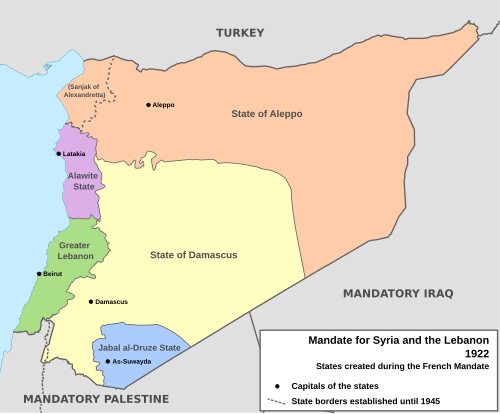
France created one artificial state and dubbed it “Syria”. The main communities in this Syria are: Sunni Muslims; Kurds, who are Sunni Muslims as well but a distinct people with a separate language and culture from the Sunni Arabs; Druze; Christians of various denominations; and finally, Alawites. France divided this entity into several sub-states: the State of the Druze in the Jabal al-Druze region in the south; the States of Damascus and Aleppo, both of which were Sunni; and an Alawite state along the coastal mountains (see Figure 1). This division was laid atop the Ottoman division that had preceded it.
Figure 1: Map of the French Mandatory Division of Territory
(Source: Wikipedia: Mandate for Syria and the Lebanon https://en.wikipedia.org/wiki/Mandate_for_Syria_and_the_Lebanon)
In 1940, France collapsed and surrendered to Germany. Conquered France was named “Vichy France”; at the same time, General Charles De Gaulle established a French government in exile called “Free France”. The British, who were worried that Syria would serve the Germans, conquered the country from Vichy France with the aid of Free France troops. The British did not plan on leaving Syria in the hands of any French though, and in 1946 contrived to have “Syria” declare its independence from Free France.
The Alawite leadership, understanding that the chances of the Alawites existing under Sunni rule were slight at best, sought to cooperate with the Jews and establish an Alawite state, but their attempts were unsuccessful. As a small nation of approximately five million, the Alawites understood that in order to survive they had to rule Syria.
Syrian nationalists tried to establish a unified country, but the country they in fact established was racked by revolution. In 1949, after its defeat at the hands of Israel, the state saw three different coups in the same year, until General Adib al-Shishakli rose to power. Many more coups followed in subsequent years. For example, eighteen military coups took place during the eighteen months between September 1961 and March 1963. In 1963, the Ba’ath Party (the Party of Renaissance) seized power in Syria. This party ostensibly championed the secular idea of Arab national unity, but in practice, the Ba’ath Party was an alliance forged by the Alawite population with other minorities in order to dominate the Sunni Muslim majority. Alawite rule in Syria, headed by the Assad family, was marked by the brutal suppression of the Sunni Muslim majority. In 2025, the regime of the Alawite Bashar al-Assad finally collapsed, and the entity known as “Syria” reverted to the state it had always been in – an assortment of ethnic and religious groups waging relentless war one against the other.
Evidently, Syria is an entity that has no “Syrian” national core capable of holding it together. Lebanon, by contrast, did have had such a core in the past, but it disintegrated due to a series of mistakes by the French and British empires.
The oldest ethnic group in the Lebanon region is probably the Druze. The Jewish traveler Rabbi Benjamin of Tudela, who set out on his travels from Spain to the East in 1165, wrote his impressions in Hebrew in his book “Binyamin’s Travels”. Upon reaching Sidon, in today’s Lebanon, he met the Druze. This is his description:
“Within twenty miles resides a nation who are at war with the inhabitants of Tsidon; the name of this nation is DRUSES. They are called heathens and unbelievers because they confess no religion. Their abodes are on the summits of the mountains and in the ridges of the rocks and they are subject to no king or prince. Mount Hermon, a distance of three days’ journey, confines their territory… They say that the soul of a virtuous man is transferred to the body of a newborn child, whereas that of the vicious transmigrates into a dog or some other animal… Jews have no permanent residence among them, some tradesmen however and a few dyers travel through the country occasionally to carry on their trades or sell goods and they return to their homes when their business is done. The Druses are friendly towards the Jews; they are so nimble in the climbing of hills and mountains that nobody ventures to carry on war with them”.[3]
Rabbi Benjamin’s is one of the first descriptions of the Druse. Since the Druse faith was formed according to scholars in mid-eleventh century, this Jewish traveler’s account is evidence that love for the Jews constituted part of their religion almost from its very start.
To reiterate, the Ottoman Turks conquered the Levant in 1517. The Turks established the “Emirate of Mount Lebanon” in Mount Lebanon, headed by the Druze emir Fakhr al-Din the First. This emirate was the initial nucleus from which modern Lebanon developed. In 1711, a Druze civil war broke out. This war weakened the Druze and led to a large exodus of Druze inhabitants to Jabal al-Druze and other locations. The vacuum that was created was filled by Maronite Christians. These Christians migrated to Mount Lebanon, and over time became a large majority. In 1860, the Maronites rebelled against Druze rule. The Druze defeated the Maronites, but France intervened militarily, and created a quasi-autonomous Maronite district in Mount Lebanon. In an Ottoman census conducted in 1911, the Maronites constituted approximately 80% of the population of Mount Lebanon.
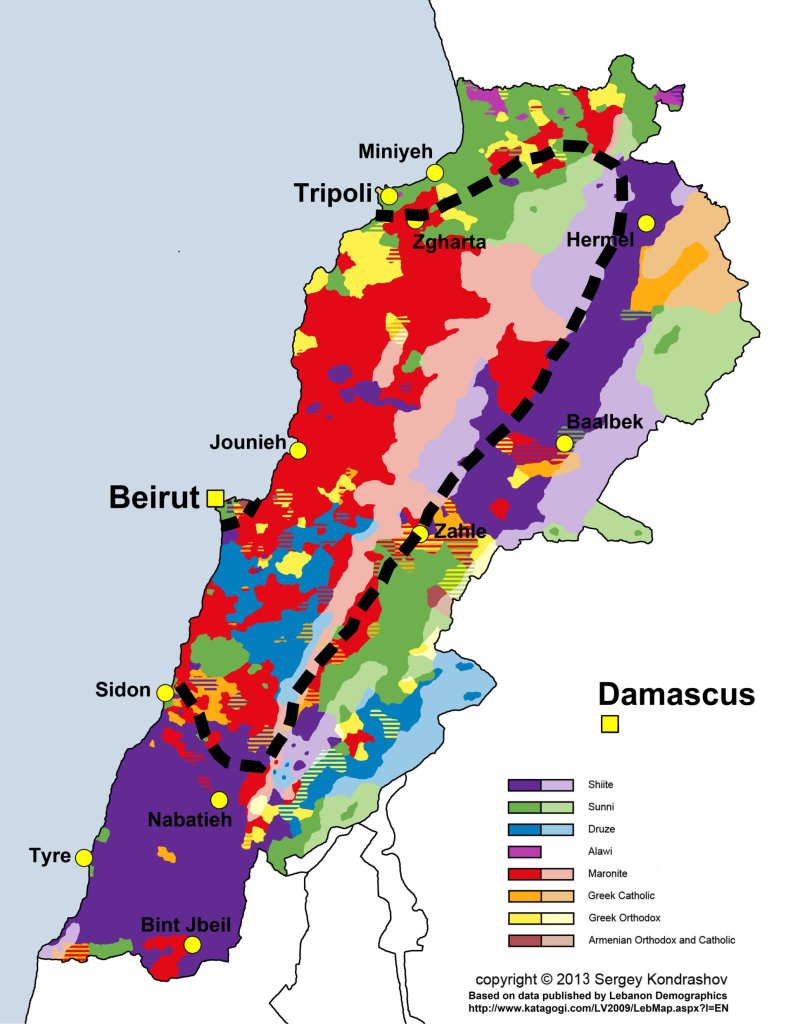
As part of the Sykes-Picot agreements, the French also received “Little Lebanon”. In 1920 they established “Greater Lebanon”, after attaching to the original Lebanese nucleus many regions that had no connection whatsoever to the original district. As a result, the Maronites became a minority of only around 30% of the population, although together with a mix of many other Christian denominations (such as Greek Orthodox, Catholics, Greek Catholics, Armenians, Syrians, and others), Christians as a whole constituted a majority of 54%. The Muslims, across their various sects (Sunnis, Shiites, and Druze), represented 46% of the population. Within this Greater Lebanon, the Druze became an insignificant minority of close to only 6%. (For the demographic breakdown of the territories of “Greater Lebanon,” see Figure 2).
From the very moment it was established, the demographic composition of “Greater Lebanon” caused it to suffer from chronic instability. Possibly, the French created this instability deliberately, with the aim of forcing the various groups – and the Maronites in particular – to rely constantly on French patronage in order to maintain some degree of stability.
Figure 2: Ethnic Breakdown of Lebanon 2012
Source: Sergey Kondrashov, Wikipedia: Mandate for Syria and the Lebanon https://en.wikipedia.org/wiki/Mandate_for_Syria_and_the_Lebanon
Like the Alawites in Syria, the Christians in Lebanon negotiated with the Jewish yishuv (population) in the land of Israel. In the early years of the British and French mandates, both Jews and Christians tried to impose some order on the unnatural border set down by the European empires. The natural border in the North is the Litani river, and the Zionist movement tried to persuade the French and British to move the border line to the only reasonable geographic contour. Attempts were made to reach an agreement with various Maronite leaders, such as politicians Emile Edde and Bishara al-Khuri, as well as the Patriarch Antonio Arida. These proposals ranged from transferring the entire territory up to the Litani to the Jews – i.e., making it part of the British Mandate – up to population exchanges centered on moving the Shi’ites residing south of the Litani and along the Lebanon Valley to Iran, and exchanging them with Maronites who had emigrated in earlier years from Lebanon. Funding for this exchange was proposed to come from the Zionist institutions. The general aim of all these ideas was to re-stabilize Lebanon with a stable Christian majority by removing the Shi’ite population.
These negotiations led nowhere, aside from the fantasy of a Jewish-Maronite alliance that has been the constant companion ever since of some elements of the Jewish public. In 1955, founder of the Foreign Ministry Gideon Rafael summarized the thirty years of contacts with the Maronites:
“Anyone who has delved deeply into or has had experience with the Maronites and their proposals for coups and rebellion knows that one must not speak of the Maronites in general terms, because they are divided amongst themselves. And they also know that when the Maronites speak of Israeli assistance, they expect Israel to do all the work for them: To clear Lebanon of Muslims for them, to guarantee sole rule for the ‘rebels’. And until the work is completed, they will sit on their hands and watch what happens. In any case of failure, our Maronite friends will be the first to betray those whom they invited to come and help them”.[4]
As stated, when France surrendered to Germany, the British were concerned that Syria and Lebanon would be used as bases of operations against them; they therefore conquered these territories from Vichy France, assisted by De Gaulle’s Free France forces. Jewish resistance units from the Palmach also participated in the takeover of Lebanon. Since the Palmach had been established by the Hagana leadership only months before, this was their “baptism by fire”. It was also the first time that forces from the Jewish community fought in battle against a regular army and gained real combat experience. The British force advanced along two main prongs: the eastern prong moved through the Bekaa Valley, with the Palmach forces accompanying them commanded by Yigal Allon; the other prong advanced in the west along the coast, with the Palmach forces attached to it led by Moshe Dayan (who lost his eye and acquired his famous eye patch in combat against the French). The military experience gained by these two commanders in Lebanon was destined to play a critical role in the IDF, which was established seven years later.
After the conquest of Lebanon, the Free French appointed their loyalist Emile Eddé as President of Lebanon. Eddé advocated a French orientation and good relations with the Jewish community residing in the British Mandate territory. But the British had no more intention of allowing the French a foothold in Lebanon as they did in Syria, under any guise. They ousted Eddé and appointed Bishara al-Khuri in his stead. Bishara forged an alliance with a Sunni Muslim leader, Riad al-Solh, and together they created an arrangement known as the “National Pact”. This pact, which consisted of both written and unwritten understandings, divided Lebanon and its governance among prominent clan families. On the basis of this pact, Lebanon gained its independence in 1943.
Since then, Lebanon has not been a state in the modern sense of the word. It is more similar to a feudal system from the Middle Ages – rule is divided among independent fiefs that theoretically recognize the sovereignty of the supreme ruler under whose authority they act. Thus, Lebanon is divided into families, who act within a complex system of sectors and clans, with state resources allocated accordingly.
On the day it was established, Lebanon attacked the fledgling state of Israel and captured Kibbutz Malkiya. Nearly six months later, Israel recaptured the area under “Operation Hiram” and advanced to a more natural boundary within Lebanon. However, under the armistice agreements, Israel returned to the old and distorted mandatory border. Since Lebanon is not a state – that is, a central government that holds a monopoly on the use of force within its territory – but rather a collection of clans maintaining a delicate balance among themselves, it has, since its establishment been perpetually on the brink of civil war. Israel was therefore compelled to act not against Lebanon as a state, but rather against various forces that operated against them from within Lebanon. Aside from the conflict in 1948, the Lebanese army – that is, the armed force ostensibly under control of the Lebanese state – was an irrelevant factor in all such rounds of fighting: on the one hand it did not itself fight against the IDF, but on the other, it refrained from fighting against the forces that were fighting the IDF. This was because the army itself is divided along sectarian, ethnic, and clan lines – as are all public services and all positions of power in Lebanon.
Given what has been explained thus far, it is clear that there is no Lebanese entity that has distinct interests. Each community has its own interests, and any talk of reaching some arrangement with the Lebanese state is meaningless. Even if there are forces in Lebanon that desire good relations with Israel, such desire has no bearing on the conduct as a whole of the loose confederation called Lebanon .
In addition to all of the above, the relations between Syria and Lebanon are not those of two separate entities. The French mandatory authorities did not bother to demarcate the border between the two mandatory territories, since from their perspective such demarcation was insignificant. Many elements within both Syria and Lebanon regarded the French separation between the two as an artificial separation that had no right to exist. Because both sides did not regard it as valid, the border between Syria and Lebanon was not marked.
For Israel, this is manifest in the location known as “Shebaa Farms” on Mount Dov. Lebanon claims ownership of it from Syria. When Israel captured the area from Syria in the Six-Day War, the Lebanese-Syrian quarrel became an Israeli-Lebanese border dispute – a consequence of the failure to demarcate the border between the two French entities. As mentioned, this peculiar incident is but one example. The entire border between Syria and Lebanon is artificial, and large portions of it are unmarked.
At the close of eighty years, it is finally time to take stock of our northern border. Israel, as a sovereign state, cannot sit idly by and watch what happens over the border from the sidelines. As a regional power it must take international responsibility, as well as national responsibility for its citizens, and reshape a new, rational and humane order for the residents of this chaotic area.
The most basic step to take is to conquer the entire Hermon ridgeline and apply Israeli sovereignty there. Control of the mountain range will allow Israel to monitor the chaos in these disintegrating mandatory entities from the heights, and manage it in a way that ensures it does not spill over into Israel. In Lebanon, the border must move to its natural location: the Litani River along its entire length, from its sources in the Bekaa Valley near the city of Baalgad, known today as Baalbek, to its mouth at the sea.
Israel’s responsibility to its citizens also obligates it to amend the border on the Golan Heights and move it eastward, while its responsibility to its allies obligates it to acquiesce to the request of the Druze along the Hermon ridge and in southern Syria and annex them to Israel. Moving the border will create an effective security buffer between Israeli residents of the Golan Heights and the chaos on the other side. This natural and self-evident border can provide security and stability to the State of Israel for the first time in eighty years.
As far as the developments in Syria itself, there are several options. One is an extension of the chaos – a free-for-all war between Sunnis, Alawites, Kurds, Christians and Shi’ites. The only good outcome from such a scenario would be that Syria would cease to be a danger to Israel, as the Syrians would be too busy with their own conflicts.
The second scenario is Turkish rule by proxy. Their only way to unite all sides in the existing chaos would be by a war against Israel and the Jews. Therefore, such a government would inevitably be hostile to Israel. While such a situation would remove Israel from the Shi’ite ring of fire forged by Iran, it would place it between the pincers of two large Sunni powers: Turkey and Egypt. The shared interest of both countries is an Israel that is small and bloodied, dependent on their goodwill.
The third and best option from Israel’s point of view is that the artificial state named Syria be disassembled back into its component parts to create a separation between populations who loathe one another, similar to the way it was under Ottoman and French Mandatory rule. These autonomous populations could be for example, an autonomous Druze region in their mountain region, an Alawite autonomy along the coastal ridge, a Kurdish autonomy in Eastern Syria and two Sunni Muslim autonomies in Central Syria – one centered in Damascus and the other in Aleppo.
Friction between these states or autonomies would be manageable. A unified Syria, by contrast, will be a graveyard for its inhabitants, a danger to Israel, and a danger to the world. A chaotic Syria will likewise be not only a catastrophe for its inhabitants but a danger to Israel, to regional stability, and to global stability. The dissolution of the British-French colonialist creation called “Syria” back into its fundamental components is within the scope of Israel’s responsibility – to itself, to its neighbors, to the world, and to future generations.
Will the change proposed also help Lebanon? Eighty years ago, such a step would have been sufficient to stabilize the country. But today it appears that the single step of moving the Israeli border to the Litani would not on its own help this wretched entity without additional radical steps.
However, regardless of the Lebanese or Syrian question, the State of Israel must take these steps for the sake of its citizens, for the sake of its allies, by virtue of its past, and for the sake of its future. At the end of the day, it is also worth remembering that this region was a distinctly Jewish region from the days of Joshua son of Nun until the end of the Second Temple period. As Simon son of Mattathias said: “We have neither taken other men’s land, nor have we possession of that which appertains to others, but of the inheritance of our fathers; howbeit, it was had in possession of our enemies wrongfully for a certain time. But we, having opportunity, hold fast the inheritance of our fathers”.[5]
Mr. Segal is a Rabbi and Sofer Stam, and holds an M.A in Middle Eastern Studies from Ariel University.
This essay is part of the collection: Two Years Since October 7: Disillusionment, Change and Struggle
[1] Moshe Maoz, Modern Syria: Political and Social Changes [Hebrew] Tel Aviv (1974).
[2] Ibid.
[3] The Itinerary of Rabbi Benjamin of Tudela: Text, bibliography, and translation pg. 61-62 https://books.google.co.il/books?id=p5oFAAAAMAAJ&printsec=frontcover#v=onepage&q=Sidon&f=false
[4] Reuven Ehrlich, The Lebanon Tangle: The Policy of the Zionist Movement and the State of Israel towards Lebanon, 1918-1958 [Hebrew] Tel Aviv: Maarachot, (2000).
[5] The First Book of the Maccabees 15:33-34 https://biblewebapp.com/study/content/texts/eng_web/M115.html