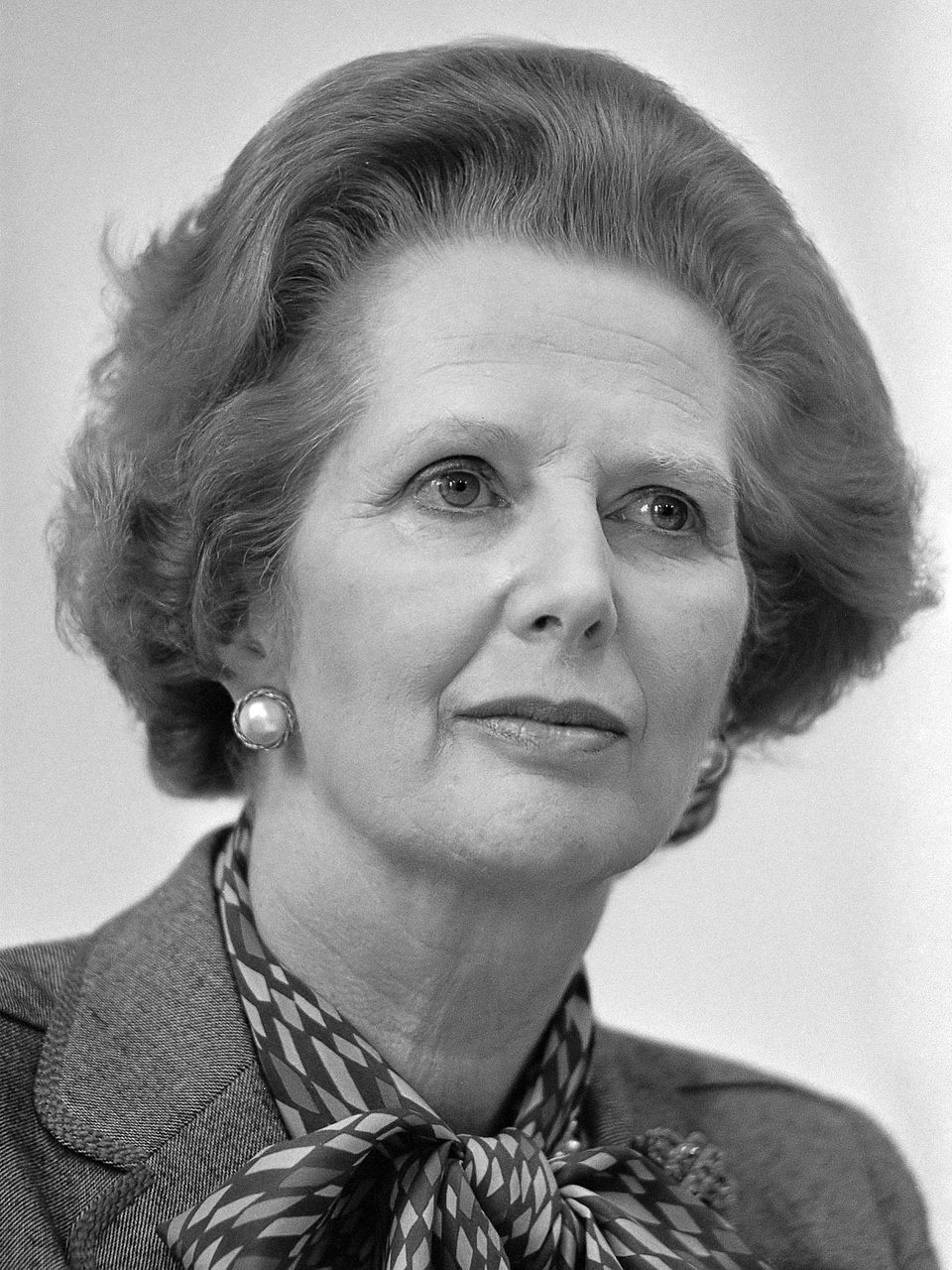
Margaret Thatcher will be remembered as one of the 20th century’s great figures. Like Winston Churchill and Charles de Gaulle, she was an extraordinary person who emerged in an extraordinary time in history. Just as Churchill saved Britain and the free world from Hitler, just as de Gaulle restored dignity and power to France, Thatcher rescued Britain from its international and economic decline. However, her achievements went beyond Britain itself: She restored liberalism and conservatism to their proper place. If the liberal idea is considered a success, it is to a large extent thanks to the Iron Lady.
It was Britain that granted the world liberalism. John Locke, Adam Smith and David Ricardo were liberal economists and thinkers in the sense that they believed political freedom was dependent on economic freedom, and economic freedom was the source of wealth and equal opportunity. However, Britain is also the land of empiricism and conservatism. Set against the rationalism of Rene Descartes, David Hume presented an empirical, skeptical approach that recognized the limitations of reason. In opposition to Jean-Jacques Rousseau’s revolutionary approach, Edmond Burke argued that tradition and national identity held something authentic and vital to society’s function.
But the economic crisis of the 30’s damaged the credibility of the liberal model, and European fascism gave conservatism a bad name. Western European countries, including Britain itself, rebuilt their economies after WWII according to a model that combined socialism and Keynesianism – a theory that cast doubt on the free market’s operations and granted the state the authority to restrict individuals’ economic freedom for the good of the general economic welfare. Within the post-WWII political discourse, the term ‘conservative’ became a derogatory epithet. Intellectuals were accepted positively only as self declared Marxists, or at least progressives.
The Wheel Turns
The wheel turned again in the 1970s. The economic crisis undermined the social-democratic (i.e., Keynesian) model. The truth about the Soviet gulags exposed by Alexander Solzhenitsyn also embarrassed the European left. Suddenly, an opportunity emerged for liberalism and conservatism to offer an alternative to the left’s bankruptcy.
But the return of liberalism and conservatism was not a foregone conclusion. In Germany, Willy Brandt pursued an appeasement policy toward the USSR (the ‘Ostpolitik’). In France, the Socialists rose to power in 1981 and formed a government with the Communist Party.
The free world needed a leader to spearhead the necessary change. Margaret Thatcher was that leader. The European intelligentsia was not prepared to acknowledge its failure, and the European left was not willing to relinquish its power. But Thatcher succeeded where others would have failed, because she not only possessed clarity of thought, courage, and determination, but possessed them in great abundance.
Enter Margaret Thatcher
When Margaret Thatcher was elected in 1979, the British economy was collapsing and the Western world was in retreat. In 1979 alone, the West suffered three defeats on the international stage: the Soviet invasion of Afghanistan, the Islamic Revolution in Iran, and the victory of the (pro-Soviet) Sandinistas in Nicaragua. In 1981, Poland’s Communist leader Jaruzelski suppressed the anti-communist ‘Solidarity’ movement.
But nothing discouraged or stood in the way of Margaret Thatcher, because she held clear principles, both in economics and in foreign policy. Liberty was her guide – individual liberty in the economy and society, and the liberty of the free world against the threats posed by terrible, tyrannical regimes. Her economic thinking was influenced primarily by Friedrich von Hayek and Milton Friedman. Hayek argued that states’ takeover of the economy ultimately led to the subjugation of the states’ citizenry, and that the free market is more efficient than any centralized economic planning. Friedman demonstrated how the state’s attempts to intervene in market forces to achieve greater equality harmed not only growth but equality itself. Thatcher was convinced by Hayek’s and Friedman’s analyses, and translated their ideas into policy.
The Stunning Success of her Economic Policy
The results were impressive. When Margaret Thatcher came to power, the British economy was paralyzed, crushed by the control of the trade unions. Thatcher lowered income tax, reduced government subsidies to loss-making industries, privatized state-owned companies, and stripped the trade unions of their ability to paralyze the economy. She encouraged households to invest in the privatized companies, creating popular capitalism in Britain. She did not yield to the coal miners’ union during the long strike of 1984–1985. She knew she was right, and was prepared to see things through to the end. That was the secret of her strength.
Thatcher pulled Britain out of the cycle of debt, unemployment, and low growth. The British economy is once again, thanks to her, a growing and thriving one. London is once again an international financial center. Britain has become today a haven for French businesspeople fleeing an economy burdened by stifling taxes, impossible labor laws, and near-zero growth. It is now clear that Thatcher was also right when she refused to join the single European currency, the Euro. That project has become a failure in which successful and disciplined countries (Germany above all) finance the deficits of countries living beyond their means, whose economies are not growing primarily because they have not carried out, and do not intend to carry out, the necessary reforms that Thatcher led in Britain. The European Monetary Union today resembles a couple that wants to divorce but refrains from doing so only because of the cost of such a procedure.
Thatcher’s economic policy had an impact beyond Britain. The economic liberalization in Eastern Europe, India, and South America in the 1980s and 1990s was grounded in her economic doctrine. Even in Israel, the 1985 economic stabilization plan was Thatcherite in every sense – though somewhat ironically, the one who implemented it in Israel was Shimon Peres, a Prime Minister from the Labour Party.
Uncompromising Foreign Policy
Margaret Thatcher also led a revolution in foreign policy. Her commitment to freedom was not theoretical, and she was prepared to fight for it. When the Argentine military junta seized the Falkland Islands in 1982, Thatcher ordered the British military to liberate them, against the recommendations of senior military and government officials, and despite pressure from the United States. She was resolute, and willing to see things through, even if that meant standing against the current. Contrary to expectations, Britain won the war, and as a result the military junta fell and democracy was restored in Argentina.
Thatcher went to war not only to defend British sovereignty over the Falklands, but also because the alternative was to negotiate with lawbreakers and appease a tyrant. Like Churchill in his time, she knew that whoever chooses dishonor in order to prevent war ends up with getting both dishonor and war.
The Iron Lady also made it clear to the USSR that she had no intention whatsoever of making compromises. Together with Ronald Reagan, she intended to defeat communism, not accommodate it. Her resolve in the face of the Soviets, her closeness to Reagan, and the bonds of trust she developed with Mikhail Gorbachev, greatly contributed to the end of the Cold War and the victory of the West. It was no coincidence that opponents of communism in Eastern Europe regarded her as nothing less than a heroine.
Thatcher showed her backbone not only against communism and Argentinian fascism but against Islamic fascism as well. She cooperated with the United States in the bombardment of Tripoli in 1986, cut off diplomatic ties with Iran in 1989, and persuaded US President Bush to wage war against Saddam Hussein in 1991. Bush dithered, and without Thatcher’s determination no international force would have been established to liberate Kuwait. Thatcher did not lead the Gulf War with President Bush because she was forced to resign less than two months before it began, but Kuwait was freed and the world had that much more liberty, thanks to her.
An Important Lesson for Israel
Margaret Thatcher gave liberalism and conservatism the chance to prove themselves once more in practice. Her legacy is more crucial than ever for the State of Israel today, as Israel suffers from problems that Thatcher knew how to fix: economic centralization, delegitimization of the national idea and tradition, and above, all the absence of political leadership with vision, courage, and principles.
Thatcher was a woman of faith, principles, and courage. She saw politics as a mission to carry out on behalf of her people and on behalf of ideas that justify personal sacrifice. She had the courage to confront the hypocritical leadership of the British Conservative Party, and by virtue of her stand against the head of her own party, in the name of her principles, she was elected against all odds to lead it. There is no doubt that politicians in Israel have much to learn from the conduct, character, and actions of Margaret Thatcher.