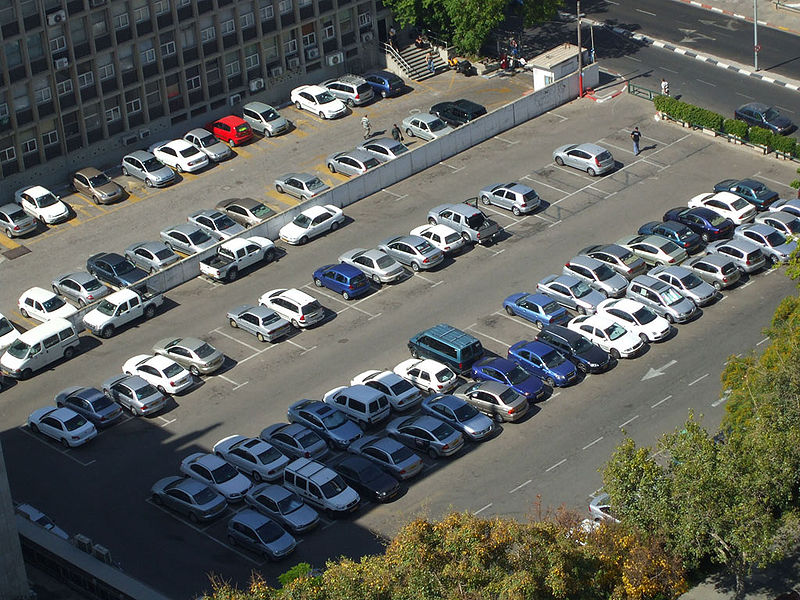
This week, The Ministry of Transport announced a pilot program for a new app named “Chaniti” (I Parked), meant to prevent the double use of a disabled parking badge for multiple vehicles in designated parking spaces for the disabled.
This move has the potential to significantly reduce such abuse of disabled parking badges. However, the current regulation of disabled parking badges is marked by two central failings: one in the issuance procedure and the other in the difficulties of enforcement against abuse. While the announced step can at least partially mitigate the difficulty with enforcement, the flawed issuance process remains unchanged, and the incentive to obtain such a badge is still significantly high.
The Ministry’s move follows a sharp increase in the number of disabled parking permit holders in recent years. There is no available source that reflects the exact number of permit holders in any given moment, but freedom of information requests filed over the years have revealed that between July 2006 and January 2023, the number of disabled parking permit holders shot up from 74,000 to more than 365,000. The significant uptick began in 2022, with an annual growth of 36%, four times higher than previous years.
The Ministry of Transport’s database shows the number of vehicles registered to a disabled parking badge to be close to 675,000, almost one fifth of all private vehicles in the country. Cross-referencing the number of registered vehicles to the number of permit holders, for years where such information is available, reveals that more than half of all permit holders use the option to register two vehicles to their badge.
Despite the fact that the law stipulates that such badges may be used only for “a person accompanying or driving the disabled person”, local authorities have until recently refrained from issuing tickets to vehicles listed in the database, even if the disabled badge was not displayed according to regulation requirements. This gave rise to the phenomenon of widespread use of the badge when not in service to the disabled person themselves. The Ministry’s new move can reduce the abuse of disabled badges mainly relevant to incidences of frequent use of both vehicles registered to the badge.
Furthermore, it will be possible in the future to add more options to the app to further reduce abuse. The pilot program only mentions disabled parking spaces but the app can be expanded to all parking spaces to prevent the misuse of the payment exemption when the vehicle is not being used for a disabled person. The app also has the potential to further reduce multiple use, by restricting, for instance, the possibility of using the badge in two different cities without ample time for travel having passed between uses. However, such a solution does not resolve all illegal abuses of the badge in the way a biometric badge would – one that could be activated only by the disabled person themselves while in their vehicle.
Although the new program offers some measure of solution to the enforcement issue, the flaws in the permit issuance are still in place. The main factor that contributed to the spike in disabled parking badges was the combination of the absence in the existing law of clear medical criteria to determine who qualifies for a badge, with the simplification and digitalization of the process in 2021 due to the Covid-19 crisis. As of now, there is no requirement for a frontal assessment by a medical professional issuing the permit. These changes made it easier to re-file rejected requests or submit fraudulent claims. Thus, among other issues, criminal cases were reported in which organized networks obtained permits using medical practitioners who worked on their behalf.
Added to this is the fact that Israel is a dense state, with a high number of vehicles in proportion to the length of road, and the fact that parking benefits in the country far exceed those of most other developed states. This combination creates an enormous incentive to obtain a disabled parking permit through legal loopholes.
In order to complete the initiative and ensure that the scarce resource of parking is allocated to those who truly need it, clear criteria to qualify for a permit must be anchored in law, with the permit issuer obligated to make a frontal assessment in ambiguous cases, similar to the model employed in the UK. In addition, a review of all badges issued in recent years should be conducted, providing a time-limited option for the voluntary return of any disabled parking badges that don’t meet requirements, in order to relatively quickly reduce the abnormal number of badges accumulated in recent years.